I’ll be honest. It’s been a long time since I’ve sat down to watch a movie. When I do, it’s usually for movie night with my family, so it’s been even longer since I had a chance to sit down and watch a WWII flick.
If you’ve been reading my blog for a while, you know that I’m picky and prefer European-made war movies over anything Hollywood has produced in the last 20 years.
Does that make me a snob, or just sick of the same old POV?
Recently, I had a night alone (!) and chose the Estonian film 1944. It has been on my TBW for a while now.
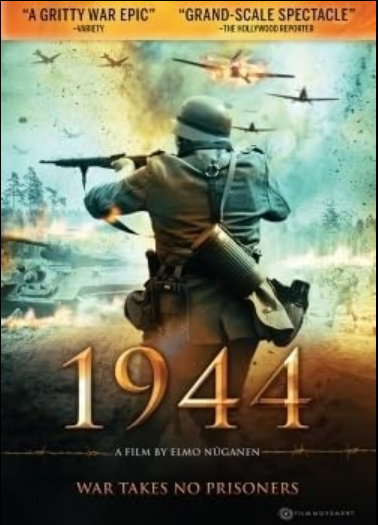
People interested in World War II are really cheating themselves if they limit themselves to American-made war movies. There are so many other perspectives out there, and the thing I love about this film is that, while it opens on soldiers clad in German uniforms and closes on Soviet uniforms, it is Estonian-perspective. Both units were composed of Estonian volunteers.
The summary on Amazon Prime says this: “Families are torn apart across enemy lines, and soldiers are forced to make difficult choices to preserve a small nation caught in the middle of a global war.”
This was the case for many small nations, but because Estonia is not part of Western Europe, most of us don’t even think about it. It was part of the Eastern (Russian) Front, and that is where the bloodiest battles took place, at least where the war in Europe is concerned.
The film doesn’t have all the bells and whistles of a Hollywood Blockbuster, but even the Hollywood Reporter calls it a “Grand-Scale Spectacle.” The only thing I disliked was the English overdubbing. I would rather have watched it in the original language with English subtitles, but frankly, I didn’t feel like trying to figure that out. (I refuse to let technology frustrate me when I’m trying to relax!)
For viewers who might be put off by the fact that the film opens on Estonians wearing the uniform of the Waffen-SS, the truth is that men who wanted to fight alongside the German forces but were not part of Greater Germany usually had to join the SS because it was not the German Army. In some ways, the Waffen-SS became the first true pan-European army and had volunteer units from nations including (but not limited to):
France
England
Latvia
Estonia
Spain
Belgium
Ukraine
Serbia
It is true that within Germany, the SS was the NSDAP’s (Nazi Party’s) political army, but that does not mean that volunteers from outside Germany supported Hitler’s politics. While I’m sure some soldiers did admire him, many didn’t. They were more concerned about what was in front of them, their family and nation. In the East, they saw the very real threat of communism, and whether or not they supported fascism, they saw it as the lesser of two evils.
The film kind of riffs on that, in fact, the Estonian “fascists” actually ridicule Hitler. It shows the dividing line between those in power and the simple soldier.
I’ve lost readers before because I took time to explain the nuances of the SS, so I’ll move on. Halfway through the movie, the focus shifts to the USA’s post-war enemy, the Russians–except again, these are not Russians, these are Estonians wearing Russian uniforms.
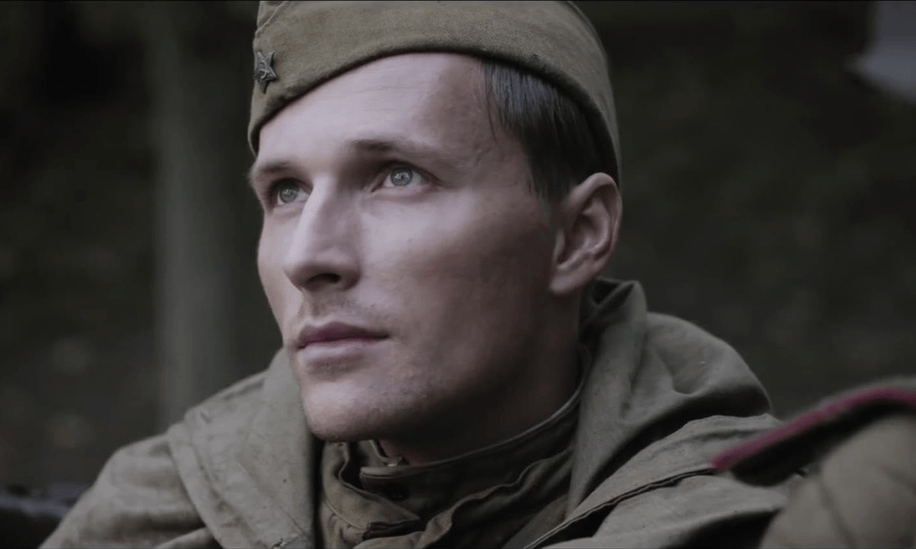
***Sidebar*** The focal character of the second half of the movie, Jüri Jõgi (Kristjan Üksküla), absolutely stole my heart because he is the spitting image of my character Christian Richter…except in the wrong uniform.
I don’t typically root for the Soviets, but these young Estonians grabbed my attention just as much as their German-aligned counterparts. You could see the way the nation, and even families, were split down the middle, and how World War II was truly a Brother War.
It made me think about how young men who wore a Soviet uniform also believed they were doing the right thing. I will allow for the fact that service in the Red Army was also compulsory, and in some cases, that compulsion was far harsher than on the German side–in some cases, they came to your home, slapped a gun in your hand, and told you to fight.
In this film, Estonia was not yet under Soviet control; Estonia had become the Front. Viewers will note the older couple who bring a meal to the young men in German uniforms, only to turn around the next day and give a meal to the young men in Russian uniforms.
The Soviet Army had commissars early on, and later in the war, political commissars were also assigned to the German forces. These men were the heavies–they made sure the soldiers were doing what was expected of them.
And this is what is heartbreaking about the film, and about war itself. Along with being my favorite character, Jüri Jõgi also has the best line:
The innocent feel guilt;
Jüri Jõgi, 1944
the guilty feel nothing.
The IMDb reviews on this film are generally positive, including a few who cite the needed perspective that it brings. Naturally, there were a few viewers who gave it less-than-favorable reviews, suggesting that it is not an anti-war film, and even going so far as to say that it could easily be seen as Nazi propaganda.
In response to the negative comments, one reviewer asks if being a supporter of Stalin was any less evil than being a supporter of Hitler. Another reviewer titled their piece, “When your survival comes down to two equally bad choices.”
I also disagree with the reviews that suggest this film portrays the Soviets as worse than the Germans. I felt it showed a good balance. The “fascists” have their political bureaucrat. The “Soviets” have a commissar attached to their unit. I guess a viewer’s opinion of how it is portrayed is going to be shaped by whatever bias they go into it with.
And I suppose I carry a certain bias as well, only because I am much more familiar with the German side of the story than I am with the Russian side. But again, I felt this film was very objective in its portrayal of Estonians on both sides. If it portrays the Estonians themselves as heroes or good guys, that’s to be expected. Americans portray their soldiers as heroes as well…the primary difference is that we have the advantage of having won the war.
Back to the movie. It was just so good, as are many of these lesser-known films. They truly give a perspective that we lack in the United States: “Was Estonia truly liberated by the Russians?”
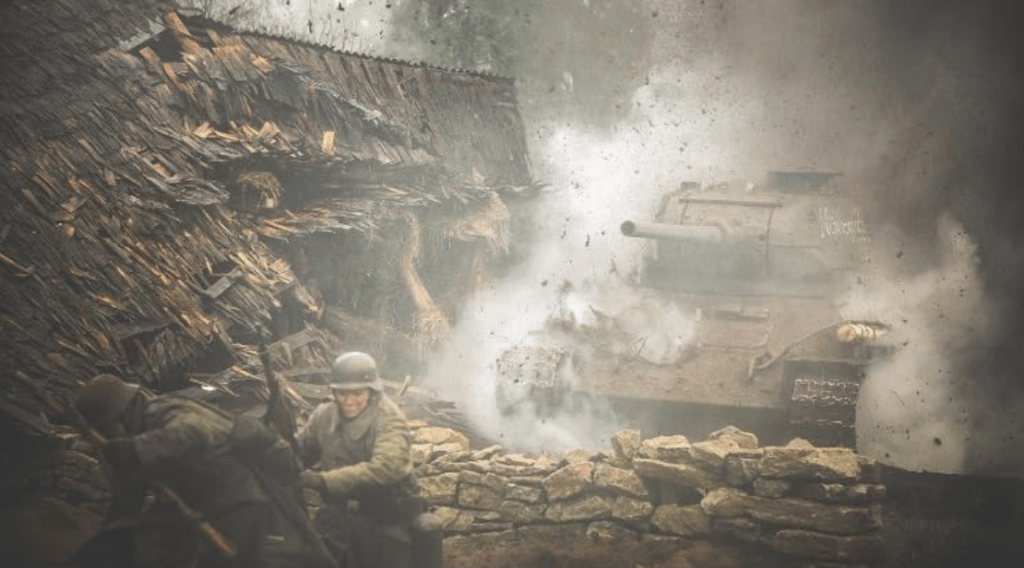
Unless you’re a student of the Eastern Front, most of what Americans know about the war in Russia is still colored by Soviet propaganda. There’s so much focus on German brutality that we forget that the Russians were brutal to their own people long before the Germans arrived, and that they committed horrible atrocities on the Germans throughout the war.
Many war crimes were also blamed on the Germans, and only decades later did it come to light that these crimes were committed not by the Germans but by the Soviets themselves. That too is hinted at in the film. When Jüri peeks out the window and sees destroyed buildings, he is told that the Russians had decimated them, and that they had been full of women and children. Jüri says innocently, “We were told it was the Germans.”
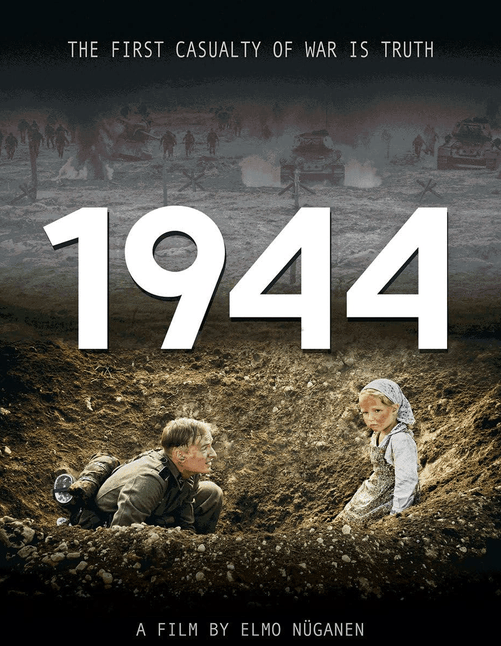
The best-known real-life example of this falsification is the Katyn Massacre. For years, the Russians allowed the West to believe that it was just another war crime perpetrated by the Germans. It begs the question: how many others are there? That is not to say the Germans were innocent, but it proves the point that in war, truth is the first casualty.
A final thought is about young men who switched sides during the war. Sometimes, it was a decision made by their government (eg, Italy and Romania). Other times, men would desert to the enemy. Perhaps they saw the way the war was going. On the Eastern Front, going into Soviet captivity meant Siberia–which was enough to push some men to join whichever side they thought was the winning side.
If you came here looking for a highly technical and detailed review, I’m sorry if I disappointed you. My reviews are often qualitative and heartfelt, based on reflection rather than giving readers a quasi-professional evaluation of a film or book.
I gave this film a 9/10 on IMDB and will absolutely be watching it again.
If you want to keep up with the latest on the Aubrey Taylor Books Blog, sign up below. Posts are published between 1 and 3 times a month and focus primarily on writing, German history and travel, as well as films and books. I will also introduce you to other authors in a variety of genres, so drop your email to stay up-to-date!