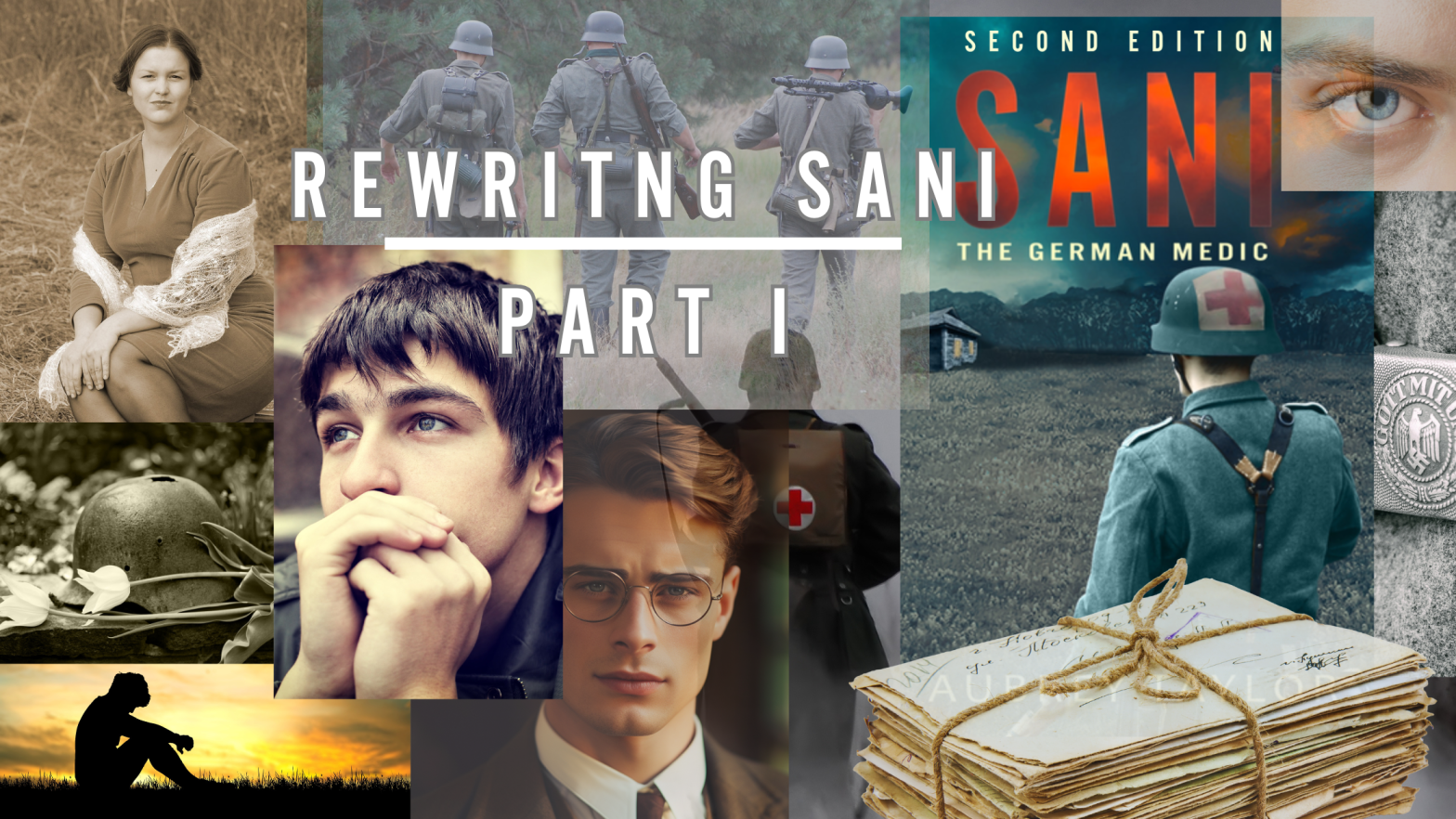
I have been toying with the idea of rewriting my book Sani: The German Medic for a few years. With the book’s FIFTH birthday coming up, I thought NOW was a GREAT time.
There is some debate among authors over whether or not it’s worth it to go back and revise/rewrite back-listed books. Many of us feel compelled to put our energy into writing new stories and letting the old ones rest, even if they’re not our best work.
Many people told me they loved Sani, and that the book stuck with them long after they read it. Why bother rewriting it? I’ll be honest: I wasn’t comfortable with it.
If it were simply a matter of the writing quality, I probably would’ve left it alone. Over time, however, I realized I had three solid reasons to try to make a good story better:
- It was my first book, and was written in 2 months. I knew nothing about modern “rules” of writing and it went without a professional edit
- It was written for the church bookstore shelves
- I no longer felt it portrayed “The German Perspective” as I’ve come to understand it in the last five years
In a new blog series, I’m going to be discussing these three in turn. (EDITED: I did flip the order, I originally intended to address faith elements in Part II.)
- Today, I’m going to take a look at some of the strictly writing-related changes I’ve made
- In Part II, I’ll be discussing some of the changes I made in the historical aspects of the book
- In Part III, I’ll be looking at the faith elements
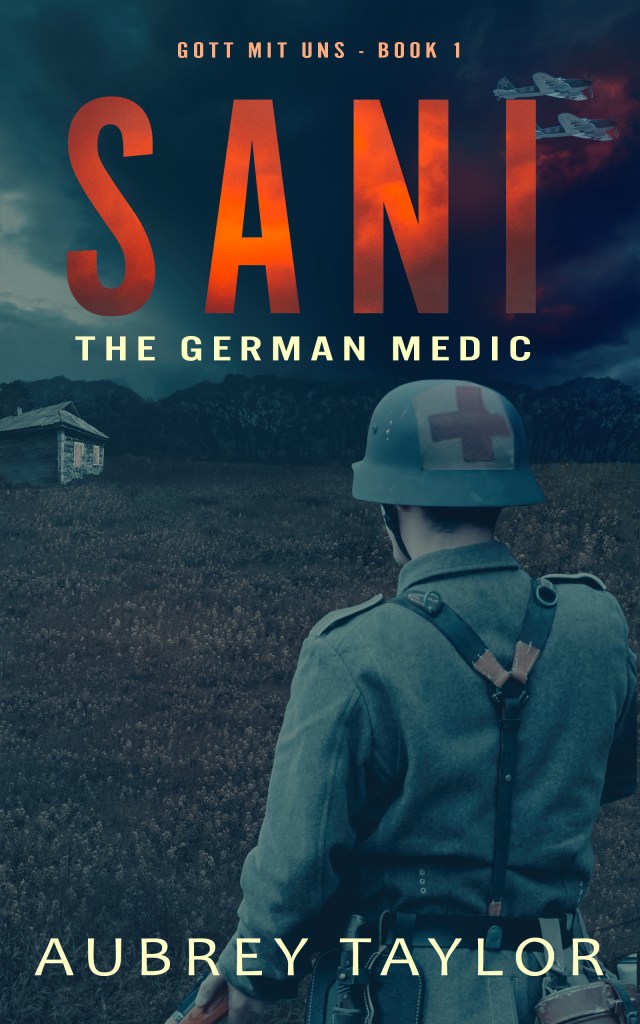
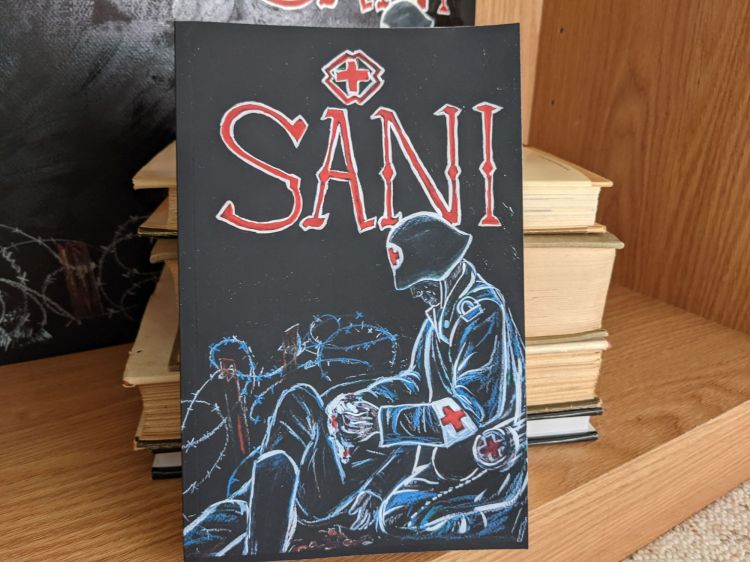
This is the original cover of the original book!
The First Edition reads like it was written by a novice, and, although I had a wonderful proofreader who encouraged me to publish it and keep writing, it went without a professional edit.
At the time, those things were enough because they spurred me forward. My writing journey has been very organic, and I don’t know if I’d really change it because the things I’ve learned along the way have been invaluable, even if they haven’t helped me sell thousands of books.
The biggest piece of constructive criticism I received about Sani was that there was a lot of “head-hopping.” I grew up before Deep POV was a thing, when omniscient narrators and telling rather than showing were still totally acceptable.
This book reflects that. Somehow, people still expressed that they experienced the story right alongside Frederick. They felt what he felt. He was like a real person.
To me, that’s a win.
Nevertheless, there was a lot of head-hopping in the original. In rewriting it, I wanted to retain the original multi-POV feel, so I did what I’ve done since: I placed the POV character’s name beneath the heading of each chapter. However, for the first time, I’ve split a few chapters between two characters, especially in the early chapters, where Frederick is still in his mother’s house. In these instances, my reasoning was simple: I did not want to create a new chapter that was only a few paragraphs long.
Readers may wonder why I bothered including POV from additional characters like Chaplain Schmidt and Krystyna, but as I went through my revisions, I felt that their “input” had value, and helped retain the original story more fully.
Besides, I’ve always kind of loved the Chaplain.
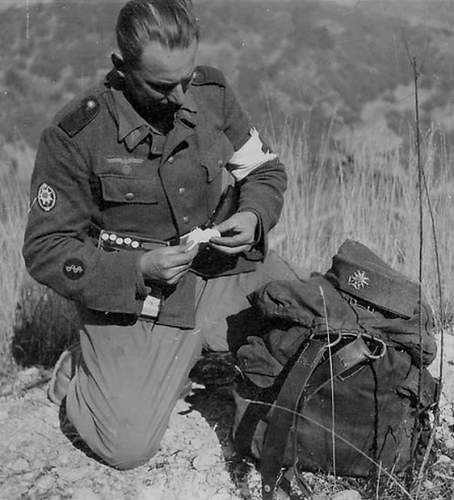
I once saw a review of someone else’s book that said: “it read like a textbook.” That phrase perfectly encapsulates the way I felt about some of the scenes in Sani. I’ve encountered it other works of historical fiction and perhaps a little of that is all right. Unfortunately, when a book feels too much like a history lesson, it can pull a reader out of the story–and this is coming from someone who loves war memoirs and history books. Sometimes, a brief history lesson can be worked into dialog successfully, but on the other hand, it can become too obvious that that is what the author is trying to do. *GUILTY*
Along with history lessons are mini-sermons. Without getting too much into the faith aspect here, I acknowledge that mini-sermons affect a story the same way history lessons do. I have gravitated toward the General Market and I want my readers to enjoy this book. Too much “Christianese” can throw a reader out of the story by losing them in theology or language that they just don’t understand or care about. That having been said, Chaplain Schmidt is a chaplain, and therefore, he got to keep some of his best lines.
More on that in another post.
Many authors struggle with “showing” rather than “telling.” It is natural to want to describe what’s going on. It’s a little harder to let the reader feel what the POV character feels, without our words getting in the way. When I wrote the book, I used the same techniques I had either used in writing as a youth, or that I had read in other books. I didn’t take the time to read up on current trends or techniques. I just wrote with my gut. Isn’t that what everyone does?
I pulled out a lot of instances of telling, and it resulted in pulling out a lot of extraneous stuff. “How do I express what Frederick is feeling right now, as succinctly as possible, yet still pack a punch?”
This post is not meant to be a writing tutorial. For goodness sakes, I’m not qualified to teach a writing skills course. However, if you want an example of the type of line I had to pull out more than once, here it is:
“Frederick did not know it at the time, but…”
For those who are interested in this sort of thing (any takers?) Below are two screenshots of a scene that I did a lot of “hacking away at.” This example actually reflects all three types of changes–writing style, dialing back on the amount faith content, and correction of historical misconceptions). Note that Version 2 has not yet gone to my editor.
In this scene, Freddie is being tempted to go back to his bottle of Pervitin, which he knows has already had pretty negative effects. (Can’t help but nod to Keilig in The Tank, who “prefers to keep a clear head.”)
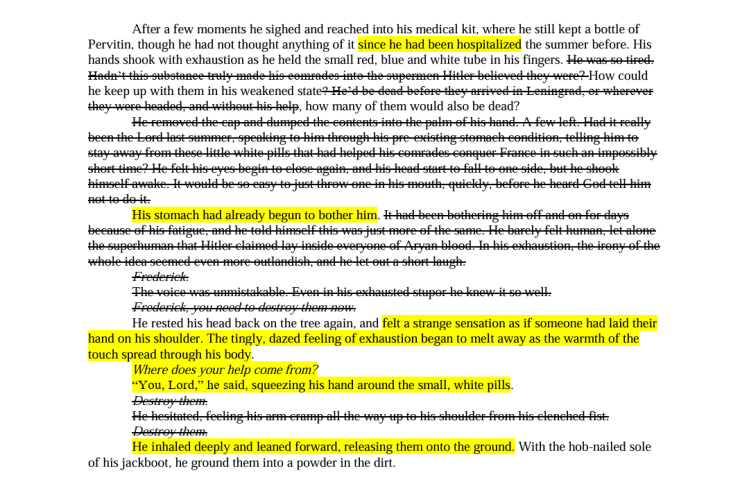
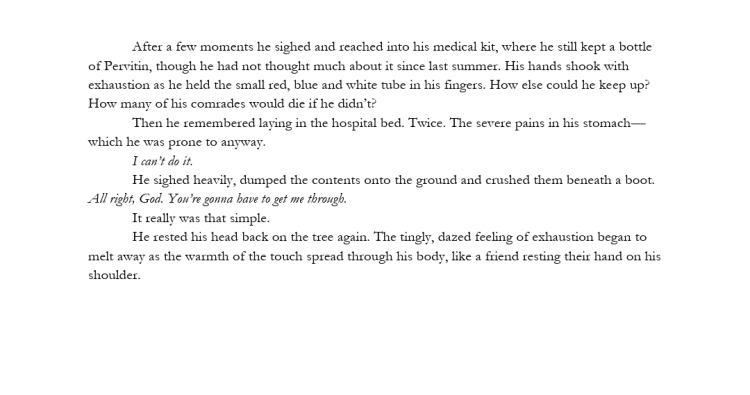
This is one of the more extreme cases of “tightening things up.” I did not go to this extreme with all the scenes in the book. Also, the highlights and strike-throughs simply provide a visual representation of my mental process, I certainly didn’t do that throughout the entire document. You can see in the example above that highlighted areas are concepts I modified or segments I moved. Areas I’ve left alone are things that were retained in the new version.
For you numbers-people out there, the old manuscript was ~83,000 words. The new one, without having visited the editor, clocks in at 70,248.
So What?
Many people told me they loved the story, warts and all. The original edition had a near 5-star rating out of 40 reviews on Amazon. Of all my books, it is the only one to ever break out of the single digits in terms of reviews (with the exception of the Brave Authors collection I was a part of, but that is undoubtedly thanks to everyone else involved).
I hated the idea of giving those reviews up, knowing that people who read the original may not circle back ’round to read and review the new edition. However, the more I thought about it, the more I decided that it’s worth rewriting, if only for my own enjoyment and discovery of the process.
PSA: Authors love it when readers leave reviews! Especially if they are a new author or an indie–we need them! Reviews don’t have to be long, and even if you didn’t love a book, say what you did enjoy, what was memorable, or what stood out.
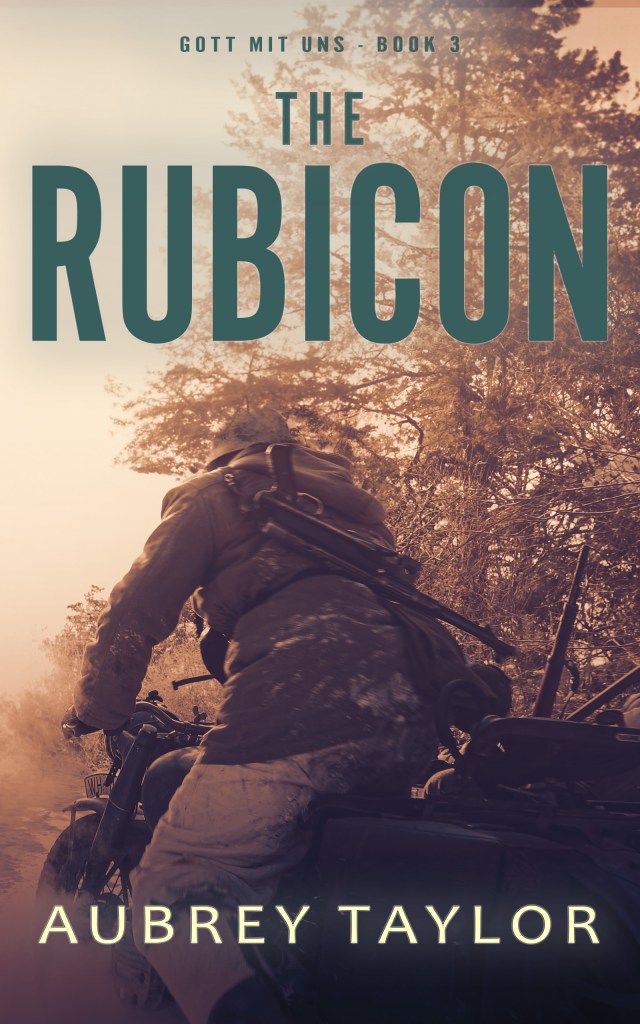
As an aside, I’ve decided to rework The Rubicon as well, perhaps not as intensively, but at the very least, it will have to match up with Sani (the two stories converge toward the end–but no spoilers!)
At this writing (January 2026), I have opened up an ARC opportunity for those who are interested in reading an advanced copy of Sani: The German Medic Second Edition and agreeing to review on Amazon, Goodreads, and anywhere else you review books. Those who tag me or screenshot their review and e-mail it will receive an entry into a drawing for a $20 Amazon gift card. (Don’t use Amazon? Let me know.)
Sani: The German Medic Second Edition will release on June 6 in celebration of it’s 5th Book Birthday. Be sure to subscribe to my newsletter and follow me on Amazon so you’ll be the first to know when the book goes live.
If you want to be informed about the latest on the Aubrey Taylor Books Blog, sign up below (Hint: for the newsletter, use the link above). Posts happen between 1 and 3 times a month, and focus primarily on writing, German history and travel, as well as films and books. I will also introduce you to other authors in a variety of genres, so drop your email to stay up-to-date!

 Aubrey Taylor Books
I have published „second edition, reviewed” for a few of my first novels. There were two, first… then a series… and I want to do it again.
It is normal for us to put up our best writing. And it is normal that people learn, in time, more things than they knew 6, 7 years ago. And if a second edition is needed, for a reason or another, why not be it revised to our best now, vs our best then, which compares only a little to now?
LikeLiked by 1 person
Very good points, yes! I’m actually enjoying the process too, it’s a new kind of challenge.
LikeLiked by 1 person