
I am thrilled to host author Jennifer Q. Hunt on my blog today. Like me, Jennifer is an author of Historical Fiction, as well as a fellow member of Brave Authors and Christian Mommy Writers (aka “Screaming Peach Books”). Jennifer’s books are a favorite among both groups. Today, she’s going to be sharing something close to my heart: the Great War and its effect on “the Lost Generation.”

“It’s hard to imagine my old plans now. We can’t ever go back. To how naive we all were before. Something shifted forever with the war, and the world will never be the same. Nor will we.” —Arilee in Through Thorny Ways
One of the most surprising things about writing stories set in and immediately after the First World War is coming to understand its profound and ongoing influence in shaping the world that followed. While several of my books explore how the war and its losses shaped each of the characters in different ways, fiction is merely a reflection of the true history of the 1910s, 20s, and beyond.
Fiction is merely a reflection of the true history of the 1910s, 20s, and beyond.
“You were a schoolgirl, Katie-love. You must have heard the best of the propaganda. Can you tell me, what was it all for?”

She contemplated. Started to speak, then closed her mouth. At last a shrug. “To make the world safe for democracy, Wilson said. I don’t really know.”
“I don’t either.” He sighed. “I guess it doesn’t matter. There’s no possible reason that could justify the horrible things that I saw.”
When she didn’t push him, he went on. “I used to think I wanted to forget it all, pretend it never happened. But that isn’t right, either. I want to remember the men, Kate, the things I learned from them. . . . I want all that loss to mean something in my own life even if I can’t make sense of it in the greater world. Maybe it had to happen, maybe it did keep things from getting worse over there and eventually over here—I don’t know. But I would to God it hadn’t been sold to us by every politician with all the promises and propaganda of a new appliance or a pack of cigarettes—and touted from every pulpit as a holy crusade to follow the Savior into a glorious destiny of defeating evil.”
In this scene from my novel Great Waters, husband and wife Russell and Katie Carver are standing atop the tower at the national Great War memorial in Kansas City. The year is 1930, and Russell is still plagued with occasional symptoms of what we would now call PTSD due to his time in the war, particularly severe fighting in the Argonne Forest.
You can visit the National World War One Memorial and Museum today (and if you ever get a chance, I highly recommend that you do) and hear the echoes of Russell’s questions. From the opening video to the final displays, the interpreters of the Great War story readily admit that they can’t fully explain what the war was about or what it achieved. While this senselessness may strike us as sad 100 years later, it was absolutely tragic for the people who lived and lost through it. Given little opportunity to process the emotions and disillusionment following the war, is it any wonder that the young people of the 1920s often turned to hedonism, earning the nickname “The Lost Generation”?
Given little opportunity to process the emotions and disillusionment following the war, is it any wonder that the young people of the 1920s often turned to hedonism, earning the nickname “The Lost Generation”?
Adam nodded. “I know what you mean. Before Josh and I and some of the other boys left for the war, the pastor at my parents’ church preached a sermon about how we were going to defeat the forces of darkness and spread the light of Christ’s kingdom around the world. Later, when it was all over, I talked to some German boys whose churches told them the same thing. We weren’t any of us fighting for some righteous cause. After the Armistice, no one knew what it was about or why it happened.” —Through Thorny Ways
One of the great tragedies of the Great War was the way it was “sold” to the average citizen in the participant nations through a blending of religion, nationalism, and advertising techniques. When the war was over in the United States, the exhausted public cried, “No more parades!” and hurried to resume normal life, the next Presidential candidate even winning on the slogan “Return to Normalcy.” For those in ravaged Europe, of course, there would be no normalcy, only seeds taking root for a second, more devastating war.
One of the great tragedies of the Great War was the way it was “sold” to the average citizen in the participant nations through a blending of religion, nationalism, and advertising techniques.
Disillusionment, a grief over the death of ideals, is a painful and often life-altering experience. Left unchecked, it leads to dismantling of belief systems, sometimes leaving the hurting person unrecognizable to those who love them.

However, disillusionment comes with a choice. It can make us wiser, rather than angrier. It can reveal lies that we have believed and set us free to seek and find the truth. Disillusionment can motivate us to greater integrity in our own lives so that we won’t be the cause of another person’s heartache.
In his outstanding book A Hobbit, A Wardrobe, and A Great War, author Joseph Loconte follows the service of J.R.R. Tolkien and C.S. Lewis and how their profound disillusionment following the Great War eventually led them to discover faith. While the exception rather than the norm, their transformation shows us that tragedy can lead to finding the truth of a God who, rather than calling us to war, offers to be our peace.
When those in leadership lie to you . . . when people you respected fail in very ugly ways . . . when victory and success don’t bring the satisfaction you expected . . . when victory and success are unattainable despite your highest efforts . . . when those you love hurt you deeply—therein lies an invitation and an opportunity. While nothing will be the same as before, the changes can be ones that lead to greater personal maturity and greater ministry to others.
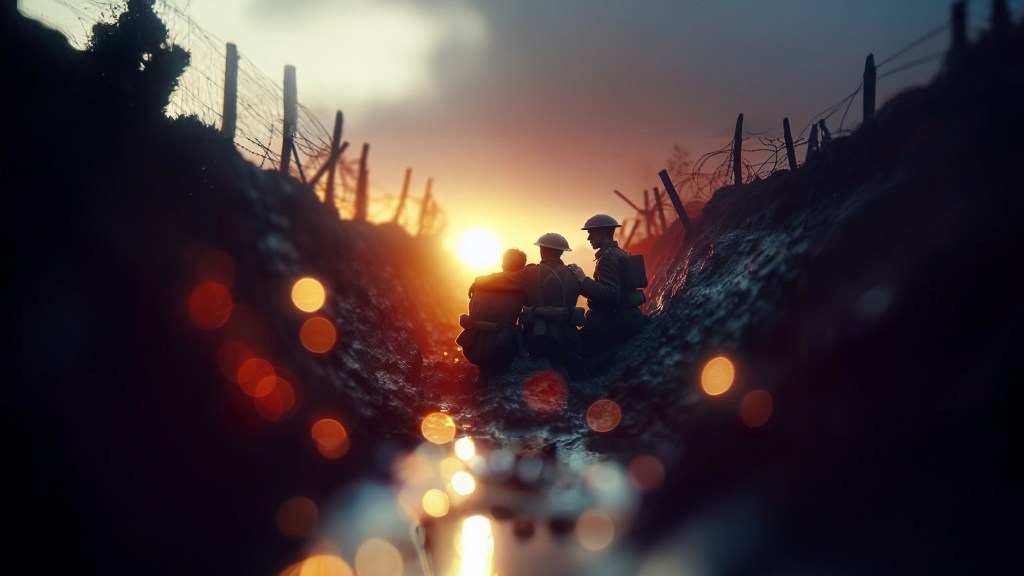
One reason I love Great War stories is because they showcase both types of people—those destroyed by disillusionment and those developed by it. This is the same choice each of us faces sooner or later, and consideration of “The Lost Generation” may help in gaining perspective of the long-term cost of those choices and how they impact the generations to come.
A powerful and thought-provoking message from Jennifer! I highly recommend her book Through Thorny Ways, which I recently finished listening to, as well as Joseph Laconte’s A Hobbit, A Wardrobe, and a Great War.

With secrets dating back two generations, will Wisteria House unite or destroy an already-fractured family?
Shrouded in scandal and secrets, Arilee Rutledge’s family is as tangled as the thorns surrounding their unwelcoming antebellum mansion. When her brother Davis returns from the Great War, she hopes they will make a new start after a season of devastation. But Davis is haunted by their younger brother’s death and his wife’s committal to the state asylum; while he loses himself in his work, Arilee continues raising his children. Determined to control at least one area of their lives, the siblings hire a former acquaintance to restore their dilapidated home.
Thrown from a carefree boyhood into the horrors of trench warfare, Adam Harrison is broken yet matured by his experiences. He takes a job updating and repairing Wisteria House, not only to pay his way through medical school, but in hopes of winning the woman he has long admired. A startling discovery plunges them all into a series of events revealing dark mysteries and shaking their already-uncertain future.
Can the thorns of grief, pain, and regret ever be cleared from their troubled hearts?
For those who love the Church, for those who have been hurt by the Church, and for those of us who are both, Jennifer Q. Hunt brings a poignant new family saga in which the challenges of life are not glossed over and hope in Christ is never underestimated. Powerful and compelling, Through Thorny Ways is a story of sacrifice and family, forgiveness and love, new beginnings and utter dependence on the Lord. Find a permanent place on your shelf, because once you travel to 1921 Atlanta with Hunt, you aren’t going to want to leave. —Heather Wood, Author of the Finding Home series.
As I said, this topic is close to my heart, especially with my upcoming release, Dearest Gunter only a few weeks away. Stay tuned for much, much more on that in the coming weeks.
If you want to be informed about the latest on the Aubrey Taylor Books Blog, sign up below. Posts happen between 1 and 3 times a month, and focus primarily on writing, German history and travel, as well as films and books. I will also introduce you to other authors in a variety of genres, so drop your email to stay up-to-date!

 Aubrey Taylor Books