
People often say, whether somberly or half-jokingly, that history is written by the victors. While some are so bold as to outright reject that statement, the documentary The Savage Peace is a stark testimony to the fact that what is taught about the Second World War has been handpicked. I know, there is simply not time to teach everything in history class–but even a lot of people who have a keen interest in history have no idea what was done to the Germans towards the end of the Second World War and in the years immediately following. Others brush these events off as if they are unimportant, a natural part of war, or simply consequences for the crimes of the Nazis.
Certain parts of history are whitewashed, or completely erased, especially where it involves those who have been on the losing side of some conflict, and even more so when it comes to those we see as guilty. If we are brave enough to seek to learn their side of the story, we find ourselves walking a fine line between trying to discover the truth and buying into everything the absolute revisionists are selling. How do I know what is true and what is a lie?
Deep down, we know that neither side has been completely honest. In my novelette, Hans Waldemar Remembers Normandy, a contemporary teenager with a keen interest in WWII says to Hans:
“I bet my uncle would love to talk to you sometime. Pick your brain. I’ve looked at some of the stuff on his bookshelves. He’s got a lot of revisionist stuff.”
“Does he?”
“Yeah. Says he knows there are some lies alongside the truth in there, but it’s the same way with the mainstream stuff. At least this way he can hear from both sides.”
“Your uncle sounds like a wise man.”
“I think he just wants to know the truth.”
“Don’t we all.”
But do we? Or are we happy with the narrative we’ve been taught? Are we willing to be made uncomfortable with the fact that we’ll never know the whole truth, at the same time having been willing to set aside our preconceived notions and given true consideration to the other side of the story?

The Savage Peace focuses on the things that were done to ethnic Germans living within modern Polish borders, as well as the Czech Republic, Romania, and former Yugoslavia, immediately following the Second World War.
No one can ever excuse the crimes of the Nazis, but the defeat of Germany after the Second World War unleashed a tide of hatred, violence, and reprisal that the world had never seen. Lynchings, hangings, burnings, rape, forced expulsion, death marches, concentration camps–these things happened to many millions of Germans throughout Europe. Nazi Party members and soldiers were not the only victims, but old men, women, and children as well.
Most of these crimes have never been prosecuted. It is as if they never happened. If history books mention these events at all, they are often downplayed. People act as though these are the “just deserts” for the nation that allowed Hitler to come into power. Or, they say, “the Germans did the same thing to Jews and other people groups, so what did they expect?”
Does that mean this information should be excluded from the history books, or relegated to a few offhand sentences, or a footnote? Does it exonerate the Allies from crimes against humanity?
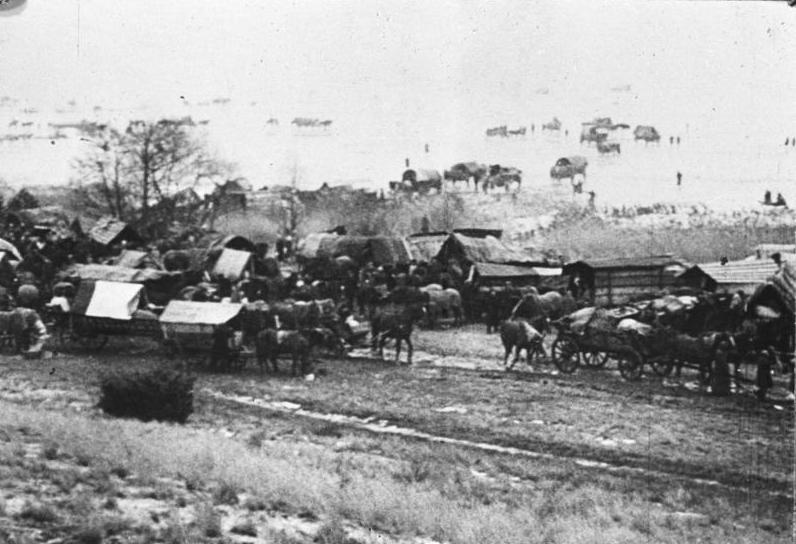
*Note: The photographs I’ve shared here deal primarily with the deportations. I’ve avoided posting pictures of more violent crimes for the sake of sensitive readers.

I like the fact that this film is readily available, because it addresses a topic that is not common knowledge outside of Germany. However, the film is not perfect. One complaint I have is that it focuses on the crimes of the Russians and other Eastern Europeans. It does not address the crimes committed in Western Europe. I realize that the film was intended to be about the crimes in the East, which were far greater in number (and perhaps severity) than those committed in Western Europe.
I also realize that in order to be palatable, we have to start with a little truth at a time (someone once told me, “people want to hear the truth, they just don’t want to hear all of it”). For those of us in the West, it is still impossible to imagine that our heroes–our Greatest Generation–may have also been complicit in war crimes.
However, if we are truly concerned about “Never Again,” events like those addressed in this film need to become a part of the narrative. Further, we have to begin to acknowledge that the Western Allies played a role in these things as well.
The film references a quotation by George Orwell, who called the mass deportation of Germans from Eastern Europe (i.e., ethnic cleansing) “an enormous crime.” Curious to find other sources that refer to this quote, I did a search online and came across an opinion article on HuffPost. Setting aside whatever end of the political spectrum HuffPost resides on, this deserves a read:
One of the most striking statements in this article, at least for me, is as follows:
“At the Nuremberg trials … the Allies were trying the surviving Nazi leaders on charges of carrying out ‘deportation and other inhumane acts’ against civilian populations at the same moment as, less than a hundred miles away, they were engaging in large-scale forced removals of their own.“
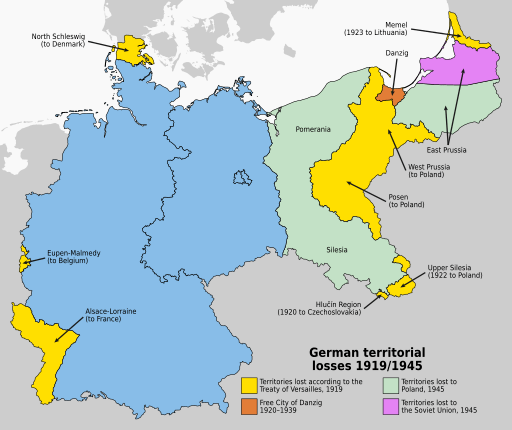
Unless one has a keen interest in European history, they may not realize the vastness of German territory before the First World War. I have had people ask me, “Where is East Prussia?!” Yet I personally know at least two people who were born there.
Below is a comprehensive map of German territory lost between the end of the First World War and the end of the Second World War. Note that all the people who were driven out of the eastern territories in 1945 had to assimilate into the region in blue, the modern borders of Germany. At that time, the nation lay in ruins. As the film says, it was a nation of women, children, and old men. There was no way to support these millions of refugees. Even today, Germany’s population density remains extremely high. Imagine 84 million people packed into the state of Montana.
Reflections on the Film… and Deeper Issues (In other words, “I Digress…”)
When I’m not researching history, I spend time trying to understand current issues in Germany. In 2017, when I knew or cared little about Germany, I was surprised to find out that homeschooling is illegal there. I was homeschooling my children at the time, so naturally I was shocked by this information. When I asked why, I was told that they do not want parents indoctrinating their children in Nazi philosophy.
Maybe that was an oversimplification, but I could think was, “Are neo-Nazis really that big of a problem?”
True neo-Nazis may be a negligible percentage of the population, but it seems to me (as an outsider) that the shame of the past, and the fear of a resurgence, have worked hand in hand to make individuals and groups that lean toward the political “Far Right” appear to be a threat, whether they are or not. Further, it is difficult to distinguish those with conservative political views from those with more extreme opinions, simply because people are reluctant to talk openly about their opinions, for fear of being labeled a Nazi.
Recently, however, the Right is experiencing rapid growth in some parts of Germany. Many of the more moderate and Left-leaning political parties (there are more viable political parties in Germany than there are in the USA) refuse to work with them.
In light of the discussion on how history has been written, I want to take a few moments to examine this. To me, it lends a perfect example of why it is so important to acknowledge “the whole story.”
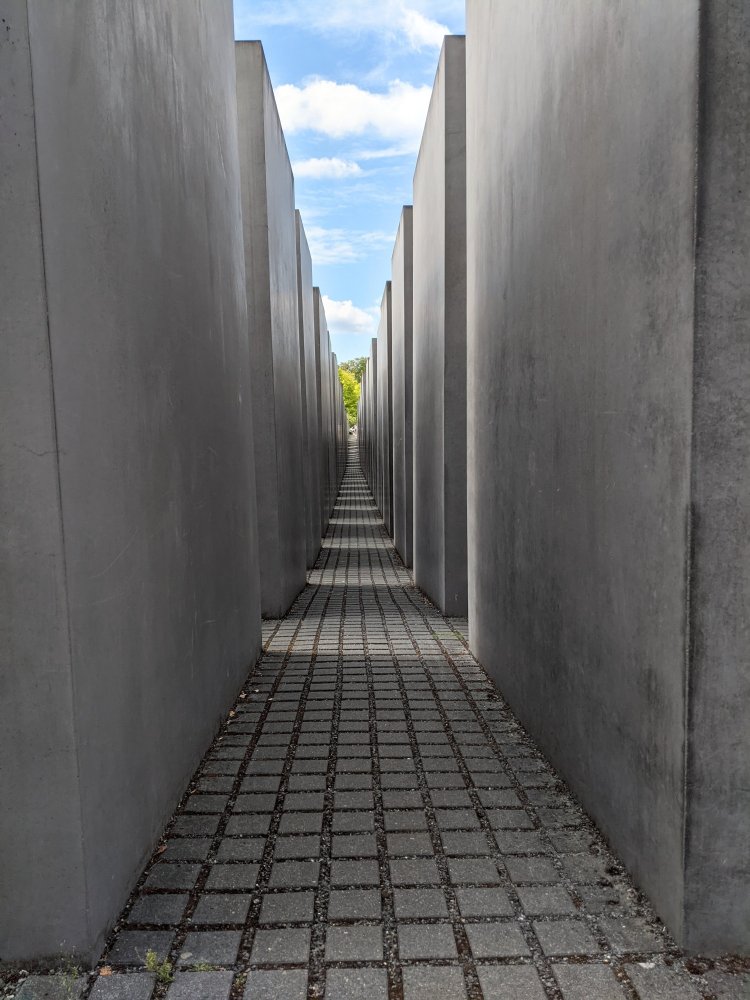
Germany has monument after monument to the victims of the Third Reich, the biggest and most famous of which resides in the heart of Berlin. A Culture of Remembrance exists in order to make sure their population understands that these things can never happen again. From what I have heard, teaching about World War II in German schools centers completely around the Holocaust. Many Germans express that it is shameful to be German–or at the very least, it is not something they are proud of.
To Germany’s credit, unlike other nations, they have owned their national sins. My fear is this: that the problem has not truly been dealt with. The generations born after the war may have heard about the things done to Germans during the war and in the years immediately following, but until recently, little has been said about these things outside of Germany. The Germans have been forced to accept them and remain silent about them because of the long shadow of guilt cast by the regime their ancestors lived under.
As I sit here thinking about all this, I have to admit, maybe its not so surprising that “far-right” politics have an appeal to so many young Germans. Not because they have neo-Nazi tendencies, but simply because they love their nation and people.
Again, as an outsider, I think many of these right-leaning individuals are just sick of having their native culture suppressed. Tired of only being proud of their country when it involves sporting events. They want to feel some pride in their heritage (the hundreds of years before 1933). Personally, I can also imagine growing tired of having my nation’s sins constantly before me–crimes that I wasn’t even alive to commit–and tired of being made to assume that my grandparents or great-grandparents were complicit in them. Tired of having my nation’s side of the story misrepresented or important pieces of it covered up entirely.
I feel like this topic deserves its own post, and I am striving to keep this somewhat relevant to the subject at hand: A Film Review and Reflections on The Savage Peace. To step down off my soapbox, I recommend watching the film and reading the article–as well as anything else you can get your hands on that gives insight into these sad chapters of history. For starters, check out the following link to my post about the sinking of the Wilhelm Gustloff–a disaster far more costly in human lived than the Titanic.
If you want to be informed about the latest on the Aubrey Taylor Books Blog, sign up below. Posts happen between 1 and 3 times a month, and focus primarily on writing, German history and travel, as well as films and books. I will also introduce you to other authors in a variety of genres, so drop your email to stay up-to-date!

 Aubrey Taylor Books
You make a really good point, Aubrey, about the fear of being labeled stifling open discussion. It’s a timely point, too, this being the last couple of months leading up to a major election.
LikeLiked by 1 person
Thank you for taking the time to comment, Priscilla. I too see a lot of parallels with some of the political issues in Germany and the current election cycle we are in.
LikeLiked by 1 person