
Today’s post will be a combined review of a book, Death on the Baltic by Cathryn J. Prince, and a German Film, Die Gustloff. Before I dive into these, however, I want to give some background on the little-known WW2 sinking of the German cruise liner, MV Wilhelm Gustloff.
By January 1945, the Russian army was pressing hard into German territory. The Wehrmacht was in a chaotic state of retreat, and the military police were pulling in any male who could carry a gun. The Nazi government finally gave the word, and a massive number of civilians from of East Prussia began to flee their homes ahead of the Russian onslaught. The great majority of these were women, children and old men.
The main collection port for these refugees was Gotenhafen on the Baltic Sea. They walked hundreds of miles in freezing weather in the hope of gaining passage on a ship bound west. Many froze to death along the way.
While there were other ships used for the immense task of evacuating the population of East Prussia, the largest and most significant ship commandeered for that purpose was the Wilhelm Gustloff, a 25-ton cruise ship that had originally been built for the Nazi Party’s Strength Through Joy program. This was a social program designed to reward German workers and their families with pleasure trips and other opportunities that they would never have had if left to their own means.
When the war began, however, the Gustloff became a hospital ship, and then a barracks for submariners in training. It did not sail for 4 years, yet was called upon to take part in Operation Hannibal, the official term for the evacuation of the German east.
Originally designed to take 1,500 cruise passengers on a luxury vacation, nearly 10,000 people were crammed on board, including crew, officers, wounded soldiers, submariners bound for the naval base at Kiel, members of the women’s auxiliary, and thousands of refugees.
There were few escort ships available to accompany the Gustloff on January 30, 1945, the day of departure. That left it vulnerable to attacks from enemy submarines, which is exactly what happened. A Soviet submarine commander who was looking for an opportunity to redeem himself in the eyes of the Russian Navy saw his opportunity in the Gustloff. Not only was it unprotected and vulnerable, in many ways, this ship was symbolic of everything the Russians were fighting against. (Though Russia was allied with Britain, France and the United States, the war of ideology between Russia and Germany took on a far greater intensity.)
Three torpedoes hit the lower decks. Water rushed in as people fought their way to safety, trampling each other in the hopes of claiming a place on a lifeboat. Many were trapped behind the glassed-in promenade deck, watching hopelessly as those who did make it to the lifeboats were lowered into the icy waters below.
It took little more than an hour for the 25-ton ship to sink. Nearly 9,000 perished in the icy waters of the Baltic. The few hundreds of survivors found it difficult to share their stories, though the memories of the disaster remained fresh in their minds decades later.
After seventy-eight years, the sinking of the Wilhelm Gustloff is still a little-known maritime disaster, though the loss of life was far greater than that of the Titanic or the Lusitania.
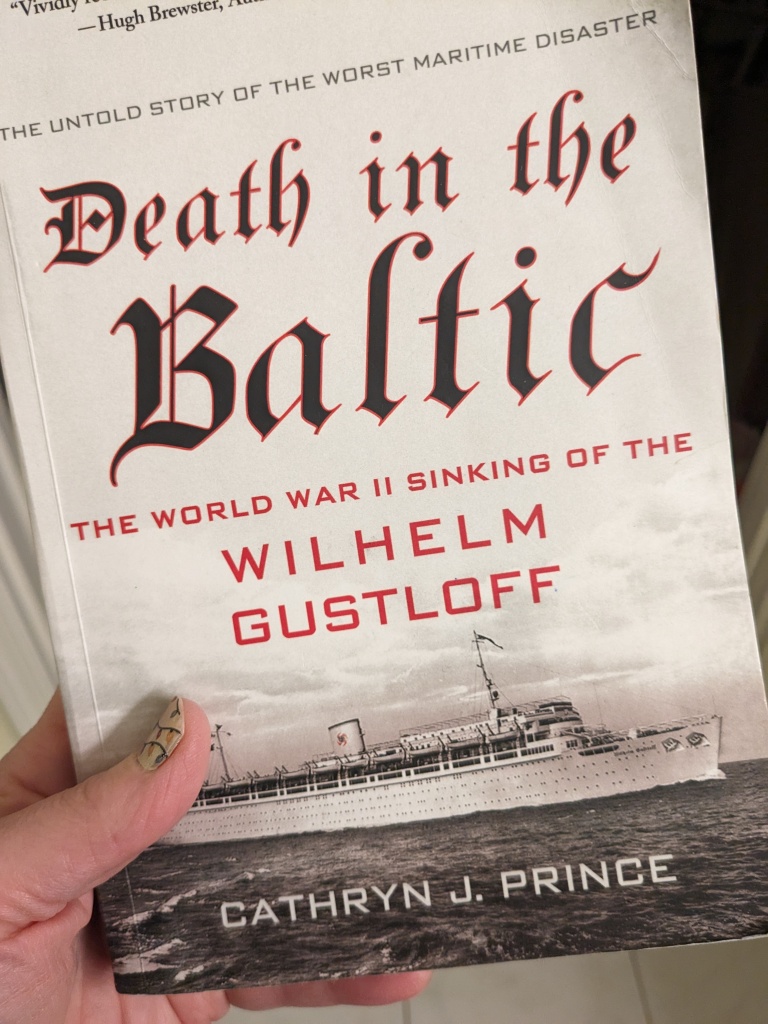
Cathryn J. Prince took a great deal of time to converse with survivors of the Gustloff and synthesize their story into a readable format. To my knowledge, Death on the Baltic is the only factual English-language account of the disaster and while I highly recommend it, I must note that there are some errors, as enumerated in a one-star review left by a gentleman on Goodreads who stated that his wife and her family members were passengers on the Gustloff.
The reviewer says he spent years researching the disaster himself and was disappointed with the account written by Ms. Prince. He states that some of the errors are historical, and some of them are just “silly” mistakes. Perhaps these were due to shoddy editing or the difficulty of obtaining precise information, I don’t know. I do know that as an author I’ve learned to take one- and two-star reviews with a grain of salt. I think this book is definitely worth a read. If you are concerned, print out this gentleman’s list and keep it with you as you read.
To dismiss the book as a whole misses the point. One can read the book to get a big-picture view of the event and allow the individual experiences sink in. Feel what the survivors felt. Think about how they could never go home again. Then think about not being able to talk about such a personal tragedy for decades afterwards. It was not just that way for the survivors of the Gustloff–it is something many Germans experienced, and to some degree, are still experiencing.
If you read well in German, consider Heinz Schön’s Die Gustloff Katastrophie instead of or together with this book. There are other sources as well, including a wealth of information on the Wilhelm Gustloff Museum website:
As with many things regarding the Second World War, concrete information can be hard to come by, especially where it involves Germany because so many records were destroyed in the war or by the order of the Nazis themselves. Also, two people can remember the same event very differently. Another key thing to remember is that the ranks of the German military do not always clearly parallel our own, and depending on the time period, even from the beginning of the war to it’s end, German ranking systems were subject to change.
I feel this story is well worth familiarizing oneself with, and this book is a good place to start. Or, you could begin with the German film Die Gustloff. It appears to be available in English (UK) as The Crimson Ocean.
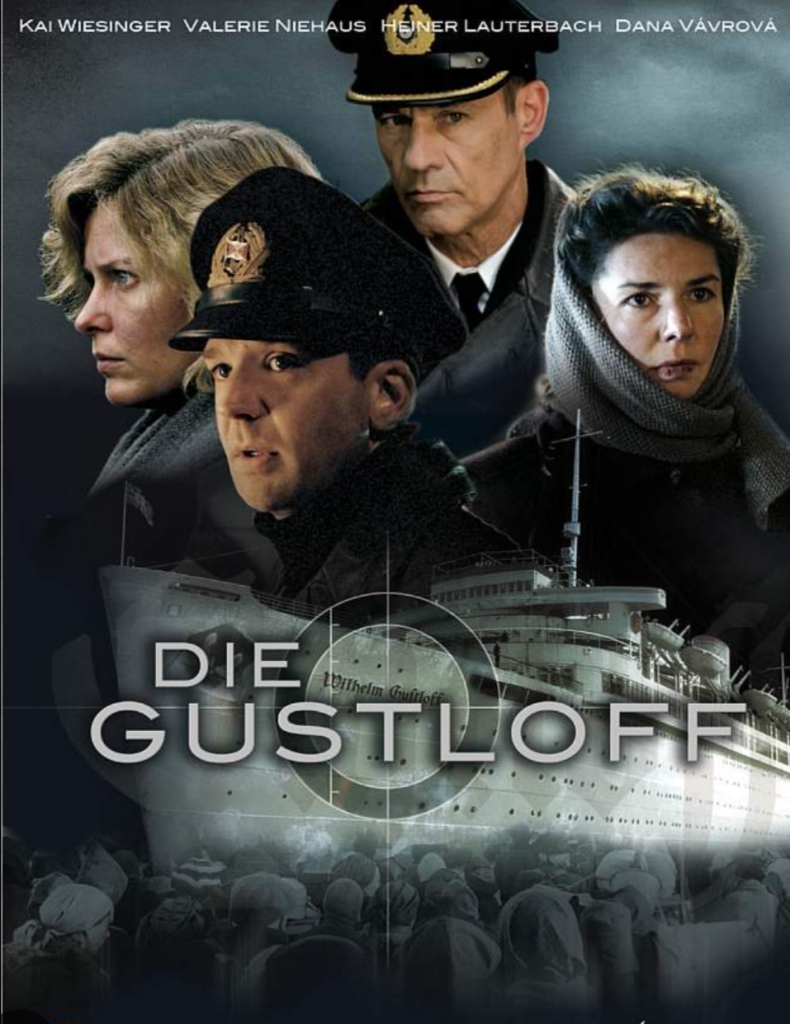
Though a work of fiction based on the disaster, this film depicts events as they may have occurred, with the likely exception of people finding each other so easily after being rescued.
Since this is a German film, it does not evoke emotions in the same way that a Hollywood film would: rather than an intense love affair and soaring musical strains, what evokes emotion is the film’s raw, honest humanity. One also cannot dismiss a confession similar to those found in most German films depicting the time period. This from Erika:
“We’re making the whole world bleed. But the war will come home to roost, and we will pay for everything.”
Erika, Die Gustloff
As you may know from my earlier review of the film Downfall, I am not primarily interested in providing a scene by scene critique of the movie. What I will give is an overall view of the film and some personal reflections.
Captain Hellmuth Kehdig has been tasked with navigating the Wilhelm Gustloff through the shallow, icy waters of the Baltic Sea. A civilian captain, he is neither a Nazi or a member of the German military. He does not think the way they do, and therefore runs up hard against the will of the other officers from the beginning.
Hellmuth’s love interest Erika is first accused of being an irresponsible member of the Marinehelferinnen (German Navy Women’s Auxiliary) and then framed as a Russian spy and saboteur. In reality she is a compassionate and caring young woman who has helped a family to stay together in the sea of chaos. Perhaps her choices are not always the wisest, but she is no saboteur.
Also present on board is a local Nazi party leader who they cast stereotypically as fervent and brainwashed, throwing a party to commemorate the Nazi rise to power in 1933 just hours before the ships demise. (You really have to love the dark humor as he clutches his portrait of Hitler while on the lifeboat.)
If you’re looking for high dramatics and special effects this is not the film for that. It is a fictionalized yet honest depiction of a horrific event, right down to the horror of the people trapped inside the glass-encased Promenade, drowning as Hellmuth with his brother, naval Lieutenant Harald Kehdig, try in vain to break the glass with an ax. (Their relationship is also worth note, because up until this point there is no love lost between them.)
As an amateur historian I beg you to take some time to consider this event. There is also a novel written by Ruta Sepetys entitled Salt to the Sea, which I have not read.
I would love to hear your thoughts in the comments.
 Aubrey Taylor Books
I think it would be interesting to watch the German film. Thanks for sharing your thoughts, Aubrey!
LikeLike
Hi Priscilla, thank you for taking the time to comment. The film can be steamed online and is only 1 hour and 45 minutes, so definitely worth watching!
LikeLiked by 1 person