
Don’t you love it when you watch a movie for the third or fourth time and notice new things? I wish I’d shared this years ago when I first watched it, but on the other hand, watching it again gave me the opportunity to appreciate things I hadn’t before. Little things, like when the main character is finally going home on leave. He pulls his wedding ring from a cord around his neck and slips it back on his ring finger.
*melts*
Of course, this film is not a love story. It is a soldier’s story, with all the trappings of a real, raw, wartime piece–and 100% NOT Hollywood. It’s not meant to be.
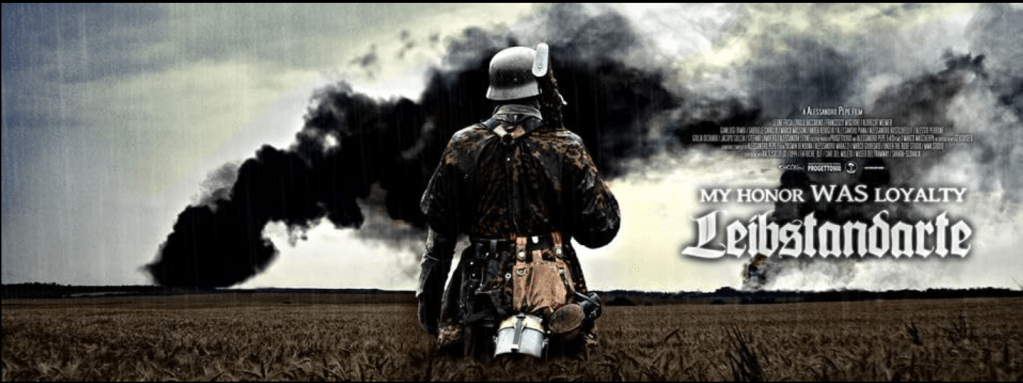
Before I go further, I want to express that this post is not intended as a denial of certain ugly truths that exist in the history of WWII or of the Waffen-SS. It’s really unfortunate that I even have to say that, but there has never been an open forum discussion on these things, and too often, people mistake objectivity for apologetics. Perhaps I haven’t been perfectly objective, but it has nothing to do with ideology, it is because I have spent five years soaking in their side of the story and have come to see them as individuals. With that comes a certain sort of empathy and a better understanding of “the other side of the story.”
My Honor Was Loyalty is incredibly underrated, and has received a lot of poor reviews, with a 4.3/10 on IMDB. One has to stop and ask why?
Remember how much people liked The Blair Witch Project in spite of the fact that (or perhaps because) it was an independent, low-budget film? I never watched it (can’t do horror, sorry) but you have to appreciate films that do not attempt to be high-level entertainment, but are created for the love of filmmaking.
Second of all, the film originated in Italy and features Italian WWII-reenactors and actors, all of whom worked for free, under the direction of an extremely talented young man. Alessandro Pepe served as writer and director, and I believe he was also responsible for composing the music.
Third, and something I can relate to, some reviewers gave it a low rating because it challenges the WWII stereotypes we’re used to. People don’t like it when we question whether or not the Allies were lily-white, and they really don’t like it when we suggest that maybe there were some good guys in the SS.
I’m going to save the heavier stuff for the second half of this post, because let’s be honest: I love this film because it challenges viewers. Because it gives us a perspective that many people still don’t want to hear. (Again, people confusing authenticity and objectivity with “apologetics.”)
But before I get to all that…
When it comes to the performance, you can’t go into this film expecting acting on the level of Brad Pitt (or, more appropriately, Thomas Kretschmann). However, reenactors know their craft. Many work at it for years, always learning, always improving, and always getting to know the men in their reenactment platoon the same way real comrades do–long weekends camping out in inclement weather, and while their guns may carry blanks, reenactment battles are no picnic (“There was sand in places I didn’t know I had.”)
The camaraderie is genuine, and the battle scenes only lack the high-cost special effects that we are used to from Hollywood. However, both camaraderie and battle scenes are highlights of the film (take note of Steiner and Scholl–their arc had me both laughing and crying).
Historically speaking, I did spot a few minor details that I wasn’t sure about–mundane nitpicky things that only people who have really researched the period and setting would pick up on. Honestly, I’ve had a few of those in my books, so there are no strikes coming from me on account of those.
Some reviewers complain about the narration and dialog. I do agree the dialog is simple, but that simplicity lends strength to the film. And yes, the narration makes us uncomfortable. There is not a lot to take away from the sting of that discomfort. It’s on the viewer to watch it with an open heart and mind, to disarm themselves and think.
I really do adore this film, and when I sat down to watch it with the intention of blogging about it, I took too many pages of notes. There is just so much I could comment on, but instead I’ll just plug it and give you the link:
Now, a few more things that stood out to me.
As I said, it’s not a love story. It’s a soldier’s story. Yet married love is woven throughout and plays a decisive role in the narrative.
A plus: no sex scenes. Just good old fashioned romance and one amazing kiss. (Yes, I needed to fan myself).
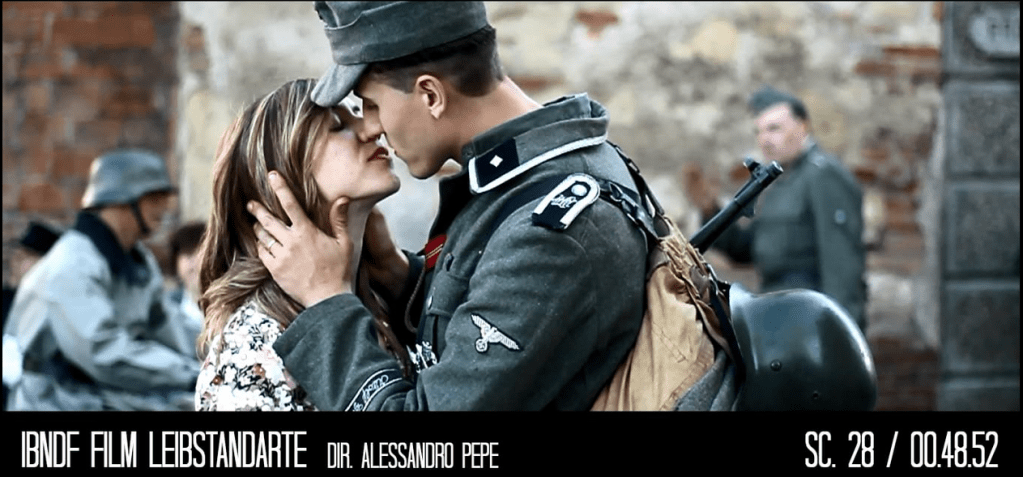
Honestly, though, I’m as much a sucker for banter between comrades as I am for a romantic subplot. The SS enjoyed a unique kind of camaraderie which is definitely portrayed amongst Herckel and his men.
I adored Leone Frisa as Ludwig Herckel. Perfect for the role in every way; he nailed it. I also appreciated Kolbe, Herckel’s superior, played by Albrecht Weimer. Though he seems more driven by orders, duty, and loyalty to the Reich, we discover that there is more to him, and late in the movie, he has a quote that really nails it:
“If we lose this war, we are cursed forever…I never killed a Jew.” It hints at the way many men–even of the SS–never participated in the Holocaust, yet the fog of guilt still hangs heavy today.
You will notice this film features SS soldiers, not the German Army (Wehrmacht). The SS as a whole was huge and varied; they weren’t just the guys who guarded concentration camps or showed up alongside the Gestapo. The term Waffen-SS refers specifically to the military branch of the SS. Some liken them to the US Marines, though I realize others might be offended by that comparison. At any rate, there was a high expectation of discipline, an “elite” status, and the Leibstandarte was basically the elite of the elite, often called to go where the fighting was most brutal.
Backing up to the 1930s, the Leibstandarte started out as paramilitary. They were Hitler’s personal bodyguard, also guarding other important figures and places of the Reich. In the late 1930’s, they created a small military branch of the SS. Then, when Germany went to war, thousands of men volunteered for the Waffen-SS, including men from the Leibstandarte, which was based in Berlin. There were dozens of Waffen-SS units by the end of the war, and they hailed from all over Europe and abroad, but the Liebstandarte-SS Adolf Hitler (LSSAH) was always considered the best, and First SS Division.
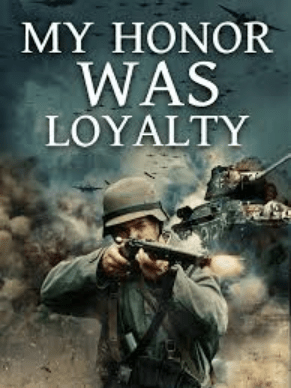
This film follows the LSSAH over at least two years of war, and much of that time was spent on the Eastern Front. Most people in the West don’t realize what the war was like on the Eastern Front, and the German soldiers fighting there became hardened regardless of whether they were apolitical or highly indoctrinated (as was expected of the SS).
There is no way a man could experience that brutality and not be changed. The Germans did not teach the Russians violence–that violence had already been happening for 20 years prior to the German invasion. Little wonder that the German population, whether provoked by propaganda or not, was terrified that the Soviets would press into Europe.
Perhaps it is fair to say that the Western Allies knew little to nothing of warfare as it was fought on the Eastern Front. Certainly, the Americans who invaded in 1944 didn’t. Yet they pressed inland from Normandy and began to face units like the Leibstandarte, who had been brutalized through years on the Eastern Front. Those are not methods of warfare one could just switch on and off, and I think that is part of Herckel’s struggle once he arrives back in Europe and faces the Americans.
Yet even without having experienced war on the Eastern Front, the Americans prove themselves to be capable of injustice, and perhaps that also rubs American viewers the wrong way.
As with most German-perspective films, there is the ever-present question of whether individual Germans were guilty of war crimes when “they were just following orders.” We don’t stop to ask ourselves whether American soldiers were also put in those positions. Of course we don’t; it is hard to imagine that our heroes would’ve carried out orders to do things that were unjust or immoral. Even if they were, it is considered justified because the Germans were the “bad guys.”
“Victory’s Glory shines light upon the flaws of the defeated. It teaches the world of their faults, but leaves in darkness the wrongs of her own doing.”
Alessandro pepe
The film drives home the fact that Germans are held guilty regardless of whether or not they committed war crimes. In fact, it is usually assumed they did, especially if they were in the SS. (Though I have been told only 6% of the Waffen-SS was actually responsible for war crimes…I will leave it up to you to investigate that number if you’re curious.)
This film is intended to share the German perspective at the time, not the modern postwar consensus. Many German soldiers and civilians during WWII would’ve looked back at WWI and thought, “We did not start WWI and should not have been held responsible for it. Now we are in another war that we are not responsible for.” They would have seen a very different side of the beginning of WWII–how many other factors were at play, and that it wasn’t as simple as Hitler being a warmonger. (To be fair, of course, there were Germans who saw him that way, just as there are always both people who love, and people who hate whoever is in the White House.)
Unfortunately, when it comes to WWII Germany, it is easy enough to brush any other opinions about the start of the war off as people being taken in by propaganda.
At one point, Herckel is asked why he joined the SS. He admits that he did it as a way of thanking Hitler, but he also explains why he felt the gratitude he did. His mother was widowed. They ate nothing but low-quality bread until the National Socialists (aka “Nazis”) gave her a job and some self-respect. They also brought back honor to his father, who had been killed in WWI.
There are very few German soldiers of WWI/WWII who have truly received any sort of respect. Their memorials are regularly vandalized and their descendants are afraid to know “what grandpa did during the war.”
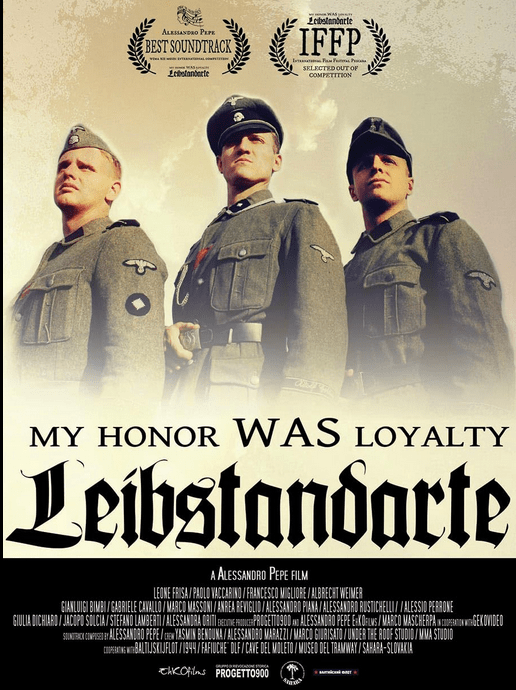
When it comes down to it, I think that is the point of this film. Eighty years on, people are slowly beginning to understand that most German soldiers of WWII were as deserving of honor as the soldiers of other armies, and that the “one good German” trope is unfair and inaccurate.
There were even good men to be found in the SS. The movie is clearly not attempting to excuse the entire organization of it’s crimes, rather, the film title itself is a play on the SS slogan, My Honor is Loyalty.
I wish there was no stigma attached to these words, because they are truly meaningful when loyalty is not misplaced. These days, loyalty means very little. People are self-focused, independent, and, with a touch of irony, we all have main character syndrome.
You can’t be that way when you’re a soldier. You have to take care of those around you, even as you wrestle with your own demons. Even when your illusions have been erased, you remain loyal to your comrades, your loved ones, and your country.
Contrary to what we’re led to believe, the majority of German soldiers who stuck it out through the end of the war were not fanatics, nor were they forced by Hitler. There are a number of quotes from the film that speak to that as well:
“We kept losing men. The war was not going to last too much longer, and the more days that passed, the more I was fighting for my wife, and my lovely Germany.”
“I love my nation. I don’t care about politics anymore. I only fight for what I love.“
Finally:
“We were destroyed and we rose and we were destroyed again.”
Many Germans pursued victory because they did not want their sons to be involved in a third war. Further, they remembered the past: they knew what communism had cost Russia.
“The Russians fought like beasts. I can’t write you about that, but for sure I will never let them put a foot on German land.”
For those who don’t believe the WWII narrative should be challenged, this film is going to be a tough sell. Yet looking at the state of the world today, all that is happening, I can’t help but think we are going to be forced into reevaluation. Younger generations are asking questions and are unsatisfied with our answers. They have access to primary resources we never did (or, had access to but didn’t bother looking at). If their guts are telling them something’s wrong, it behooves us to set aside our pride and investigate a little ourselves, rather than clinging to well-worn stereotypes and pat answers.
I’m not saying throw everything out. Film is a good way to consider other sides of the story…if we’re open to them.
Also, if you want more movie recommendations, check out my Book and Film Recommendations and scroll down about 3/4 of the way.
If you want to be informed about the latest on the Aubrey Taylor Books Blog, sign up below. Posts happen between 1 and 3 times a month, and focus primarily on writing, German history and travel, as well as films and books. I will also introduce you to other authors in a variety of genres, so drop your email to stay up-to-date!

 Aubrey Taylor Books