
It seems like forever since I did a film review… that is not to say that there aren’t reviews sitting in my Drafts folder… But this one, I thought, was timely.
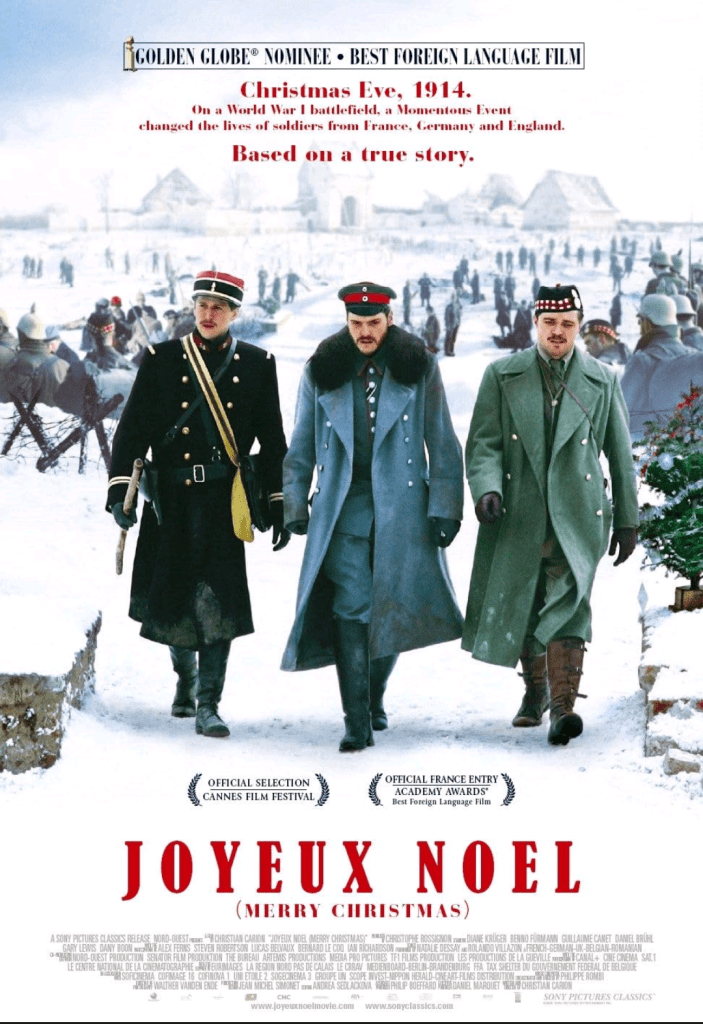
I’m always on the lookout for films that are appropriate for my children. With one of them being 15, that has gotten easier, but my 8 year old is still tough.
In spite of one scene in which my husband had to hit fast forward (about 30 minutes in), I chose this film not for historical accuracy but for food for thought. Those who are looking for a rough depiction of war will be disappointed: the point here is not trench warfare. Certainly, the war would drag on for another three years, claim millions of lives, and nearly destroy the foundations of society.
But these truces took place before all that. This film is all heart, along with a good dose of humor, and while one can call the accuracy into question, the truth is not completely lost.
***Beware: Spoilers Ahead***
The event depicted is the well-known Christmas Truce of 1914. The setting is one point along the seemingly endless Western Front. In truth, these unofficial truces happened in multiple locations, and were probably not limited to Christmas Eve or Christmas Day.
The picture below from Ploegsteert, Belgium, is one of the most famous depictions of the event:
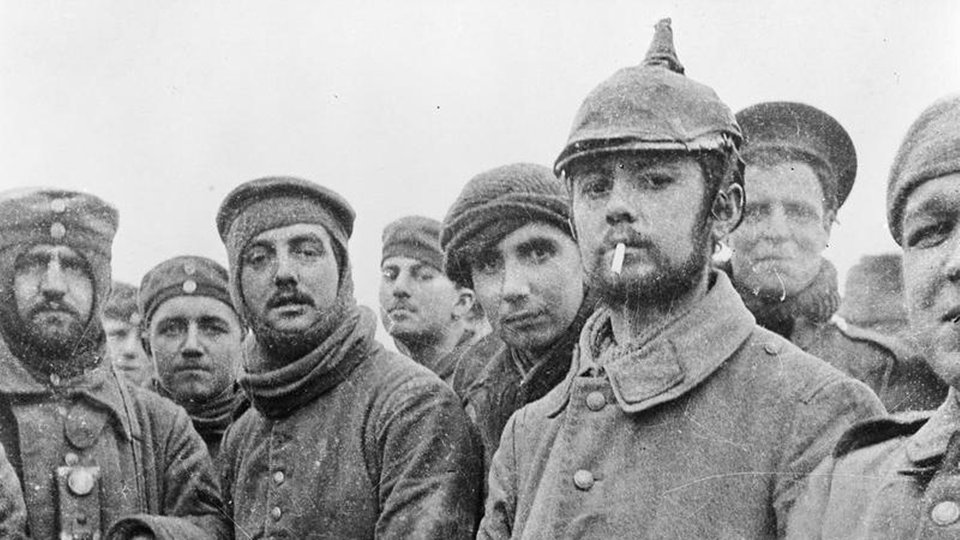
The caption from the Imperial War Museum: “British and German soldiers fraternising at Ploegsteert, Belgium, on Christmas Day 1914, Front of 11th Brigade, 4th Division. Possibly Riflemen Andrew (middle) and Grigg (second from the right, background) of the London Rifle Brigade with troops of the 104th and 106th Saxon Regiments.”
There were soccer games, exchanges of wine, cigarettes, chocolate, and lots of singing.
In the film, the whole event begins with singing. German opera singer Nikolaus Sprink has been drafted as a frontline soldier. Called away from the front by a joint effort between his girlfriend and the Crown Prince, Sprink cannot enjoy the comfort of a Christmas Eve with high-ranking officials: he sneaks back to the front to sing for his comrades.
Soon, the Scotsmen across the way bring out their bagpipes. There is a bit of a “volley” of music, and Sprink emerges from the German trench, singing Adeste Fideles, the Latin version of O Come All Ye Faithful, which men in every army would’ve been familiar with. Soon, more Germans emerge. The Scots emerge in turn, and the French realize–it must not be some German trick.

Internet, Public domain, via Wikimedia Commons
They all knew the war would not be decided over one night of peace. And that truth, too, is depicted in the movie.
Of course, there continue to be prejudices, and vengeance. As much as we want to believe that children aren’t born with the capacity to hate, the Bible says something different: the heart is deceitful and desperately wicked; who can know it? The truth is, a small capacity for hatred can be fanned into flame: the film opens with French, British, and German schoolboys, each individually being made to repeat what they believed about their enemies.
Propaganda was heavy on every side.
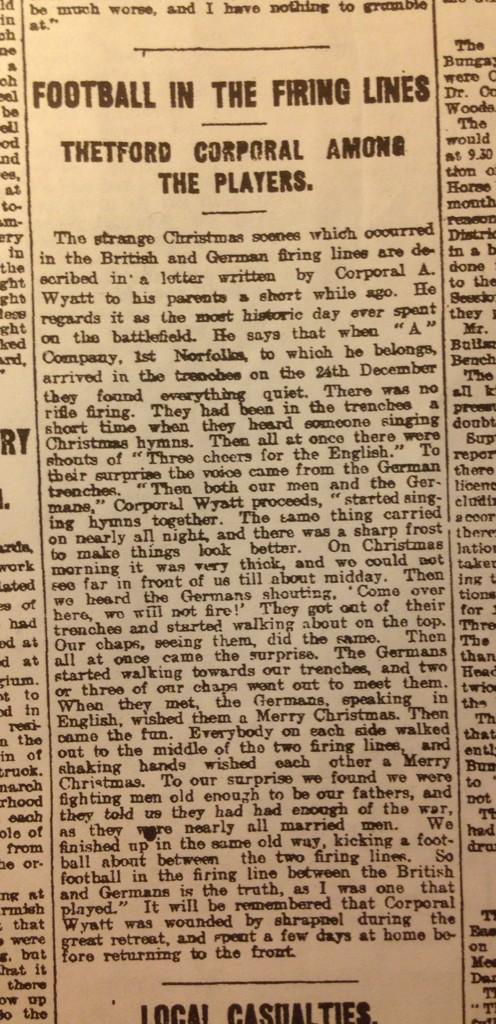
(LEFT) Clip from Unknown UK newspaper, Public domain, via Wikimedia Commons
—
Christmas was (and is) seen by many as a time to set our hatred and agendas aside… In the movie, that sentiment is quashed as the Generals and others in power come along to set things “right.”
The theme of the fighting man’s resentment against those who sit comfortably behind the lines, making decisions while others suffer and die is a common thread throughout much of war literature and film.
Often, when brought face to face with the one he was told is an “enemy,” the common man asks, “Why do we hate these guys so much?”
As I said above, I thought it was a good film to get my sons thinking. Other than the one bedroom scene, I felt comfortable showing this to my 8 year old. My 15 year old enjoyed it and had a lot to say–especially over a scene later in the movie where the Scottish priest-turned-medic is reprimanded by a superior priest for sharing a Christmas sermon with the enemy.
Afterward, the superior priest goes in to preach to the replacements–men who have not compromised by fraternizing with the enemy. This “man of God” goes so far as to call their fight a crusade–a holy war. (Of course, one may guess that the German priests were likely saying the same thing to their congregations, each conveniently forgetting the fact that they shared a common Christian faith.)

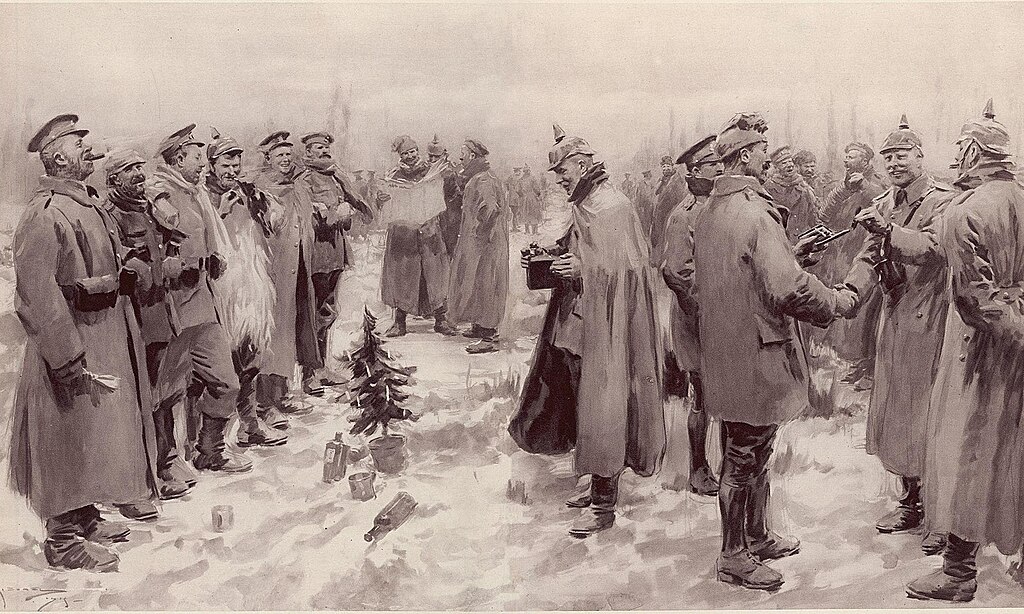
British and German officers meeting in No-Man’s Land during the unofficial truce. (British troops from the Northumberland Hussars, 7th Division, Bridoux-Rouge Banc Sector).
Public domain, via Wikimedia Commons
It is at this point that I have to give a nod to the cat–Felix, or Nestor, depending on which side you ask–because animals are always a draw and even this poor critter does not escape the consequences of the Christmas truce.
I’m a realist. War is terrible–but I do not see anything about humanity that gives me hope that, left to ourselves, we will ever truly eraditcate war from our world. As long as there are men who seek to create strife and further their own agendas,–whoever they may be–who do not abide by the rules of what others think is correct and decent, there will be a need for men who are willing to stand up and fight. To defend their homeland and their family.
This movie makes me appreciate those who are willing to take on the nuances involved in war, instead of relying on stereotypes we so often see–more pronounced in WWII movies but present also in WWI films. I think this is what I appreciate about international films. They do not rely on the tropes we do in America. (Of course, in this instance, the film did not involve Americans at all: in 1914, the Americans were hoping to stay out of it.)
I don’t usually include links to the films I review, but this is easily available for rent on Amazon Prime and YouTube:
If you want to be informed about the latest on the Aubrey Taylor Books Blog, sign up below. Posts happen between 1 and 3 times a month, and focus primarily on writing, German history and travel, as well as films and books. I will also introduce you to other authors in a variety of genres, so drop your email to stay up-to-date!

 Aubrey Taylor Books