
As you can imagine, the 80th Anniversary of V-E Day takes on a different meaning for me as an author of German-perspective WWII Fiction. I’ve grown to love “my boys” in Feldgrau and the nation they fought for. It has nothing to do with the politics of the German regime at the time, but it has everything to do with uncovering unending questions and doubts, and asking myself why I ever got into this.
Lots of fiction authors have undertaken to research and write about the difficult topics surrounding WWII. The research is inherently disturbing and sometimes personal. As stated above, it has become so for me in a way I never expected, never intended, never wanted.
In the beginning, I used “safe” research material. I stuck to mainstream history. Anything outside of that narrative was verboten. Thankfully, reading German soldier memoirs was something I considered safe because you can’t argue with an individual’s memories, perceptions, thoughts, or feelings.
Revisionist histories, however, were off limits, and the thought of reading primary sources from “the Nazis” gave me hives.
As it became apparent that this was going to be my niche, I had to change my approach. Nothing was off limits anymore. For the sake of honesty and truth in my writing, I had to understand.
With any other topic, people would certainly agree that reading primary sources is the best way to research history. So why should it feel weird to pick up something written by, say, Joseph Goebbels, or AH himself?
The first argument is, of course, “It’s all just propaganda.” After picking up old books that were clearly American Anti-German propaganda, I had to confess that everyone involved was playing the game; all nations used it, and some of the Allied propaganda was quite brutal.
It also seems that people avoid using primary sources from the Third Reich because of the assumption that the Nazis were uniquely evil, and that this evil renders their writings and speeches useless for historical understanding and truth.
I do not want to play a game of “Who was more evil?” but I have a point to make below, so stay with me.
Was the Nazi Regime truly the most wicked thing to arise on earth in the 20th Century? If we believe that, it assumes that Communist Russia was less worthy of condemnation. Yet if one looks into the history of the Stalin regime for any length of time, they will immediately see why so many Germans were determined to keep “Bolshevism” (as they called it) out of their nation, and out of Europe. It was bloody and brutal. Many more human lives were sacrificed in the name of Communism than in the name of Fascism.
Side Note: A lot of people today tell me they didn’t even realize that the Germans were fighting against the threat of Communism. I’m not sure exactly where that aspect of it got lost, because it’s all over in their original documents.
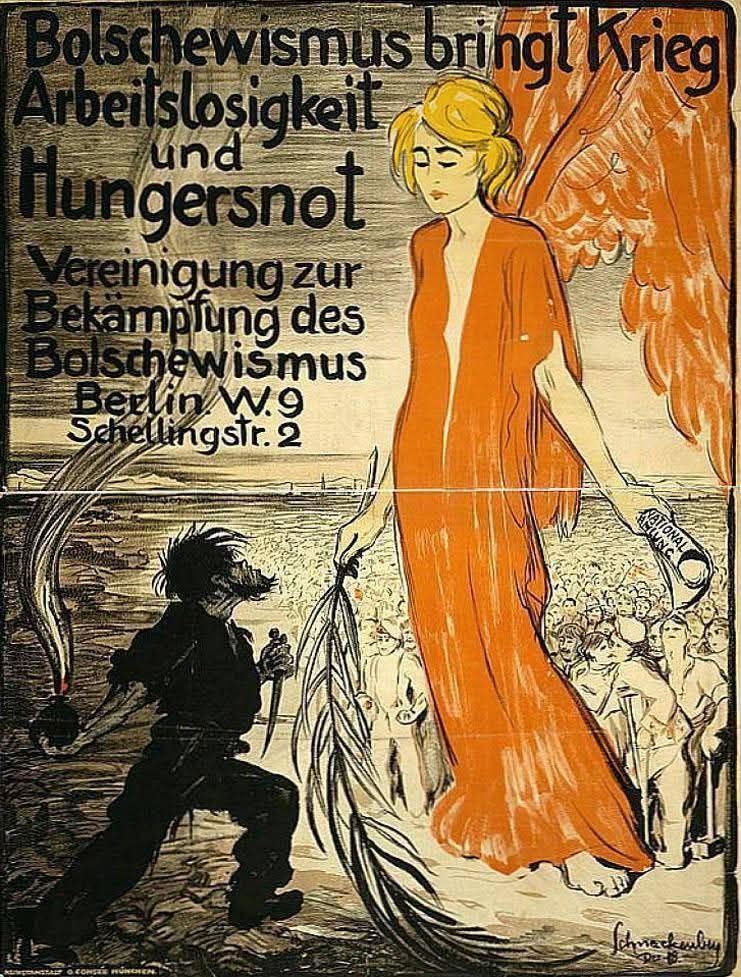
Association for the Fight Against Bolshevism.
Still with me?
There is also Weimar Germany, which is hailed as an artistic powerhouse and an attempt at democracy that ended too soon. Beneath the surface, however, it was a cesspool of perversion and debauchery the likes of which rival what is going on today in the United States (think of the most vile forms of pornography and human trafficking). I know people want to allege that the Nazis were just a bunch of perverts (and undoubtedly, some of them were, because perverts exist in every corner of society), but Weimar was truly an “anything goes” society.
I think that minimized or forgotten evil is more dangerous than the evil that stares us in the face. There is so much focus on how bad the Nazis were that we don’t seem to understand that Communist ideals are alive and well in our society. We also don’t realize that a lot of what we call “freedom” is actually destroying the moral core of our society.
What About Revisionist Sources?
People are usually open to discussing different views of other periods of history, but when it comes to the Second World War, anyone who expresses an opinion that varies from the accepted narrative is in danger of being accused of being all sorts of things: A “Revisionist.” A Conspiracy Theorist. A Holocaust Denier.
I’ve also come across a lot of people who want to argue whether or not history is truly written by the victors. The one thing we can all agree on is that history has been written. Indeed, there is a specific version of written history that exists.
One person argued with me that “the German generals helped write the history of the war.” “The narrative has been ‘institutionalized’.” That may be, but the German generals, in wishing to comply with the Allies, had little understanding of the experience of the average German citizen or soldier. The soldiers complained all along that the generals, far away from the front, had little concept of what was going on. Indeed, the soldiers had a very different story to tell, and some have done so in their memoirs. The citizens had their own misery, and toward the end, it was bound up with the lives of the soldiers.
Whether or not the narrative was institutionally agreed upon, the fact of the matter is, the great majority of Germans have remained silent all these years. Even the Allied veterans had a hard time talking about what their wartime experiences, without the added guilt and shame that the Germans carry.
What the descendants of the Allies perceive as revisionism was in fact truth for many Germans, and it still is truth for their descendants. But, as they have been saying for 80 years, “These are things we can’t talk about.”

If we really want “Never Again,” we’re going to have to talk about these things.
A reasonable person would readily admit that there can be more than one account of the same event. A witness describing a carjacking from the right side of the vehicle might say there were two children in the backseat. A witness standing on the left might have only seen one child.
There are countless issues on which revisionist accounts may diverge from the accepted narrative, yet none of them are points people want to consider. It’s as if people just shut their ears to them. For example, when I bring up the horrible things that were done to the German population by the Allies, I’ve had it thrown in my face that “you can’t equate the crimes of the Allies with the crimes of the Nazis.”
People have been asking, “Have we learned anything?”
I would argue that we haven’t, but it is not for the reasons people think. I said it above, and this might be the hill I die on, but if we truly want “Never Again,” we have to be willing to investigate the entire picture. We have to be willing to have difficult conversations, to look into the parts of history that are considered “verboten,” and read differing viewpoints on the issues.
We might even have to set aside pride in our nation and admit that our leaders have not always been godly men with good intentions either. That has become abundantly clear in more recent years, and I can say that without offending either side of the aisle, because both the Right and the Left have accused each other of conspiring to reorder our society in a ruthless and terrifying way (The Great Reset, Project 2025, whatever).
When we consider the nature of mankind, it is naive to believe that we have been lied to about many other things, but that the WWII narrative, which is so central to our time, is without fault and needs no reconsideration.
That ought to give people pause. When we look at the condition of the West today, I think we would do well to go back and revisit the narratives we’ve clung to so tightly. There must be open discussion.
I say this, and I have not even formed any conclusive opinions. After so much reading and research, I can’t help but see that something is amiss, and as a Christian I see the implications if we do not heed the warnings. We can laugh at all the Tik Tok/Instagram reels out there that are already, tongue in cheek, blaming Germany for World War Three, but consider for a minute: what if the narrative has been tampered with? What I’m about to say will resonate more with readers that share my Christian faith, so if you don’t see things through that lens, bear with me once again:

It is a chilling thought that God promises that He will shine His light.
The Bible warns not to call everything conspiracy that other people are calling conspiracy (Isaiah 8:12). However, the Bible also gives accounts of a number of conspiracies, beginning in Genesis 37 when Joseph’s brothers conspired to kill him, and ending with the conspiracies against Paul in the book of Acts. Furthermore, in the Old Testament, God spoke to His prophets, exposing evil men who were making evil plans:
The Spirit said to me, “Son of man, these are the men who are planning evil and giving wicked counsel in this city.” Ezekiel 11:2 NLT
Certainly, conspiracies do and have existed since time immortal.

Let me be clear: I am NOT saying there are not ugly truths about what the Germans did during the war. Its war. Everybody was guilty. But one really has to consider how much energy and focus has been put into making the Germans exponentially more evil than every other evil that existed on the face of the earth for the last 100 years.
I admit, the whole thing lends itself to a great narrative. However, I want to challenge my Christian author-readers: we need to set a new standard by separating truth from tropes. Yes, there is artistic license in fiction, but if we are truly interested in reflecting history truthfully, we have a lot of work to do.
Germany as a nation has had its day of reckoning. It has paid more than double for all its sins. What happens if a day of reckoning comes for those who have laid 100% of the blame at Germany’s feet, and hidden the sins of their own people?
We can’t know all the ins and outs of history. However, we can be open to learning, and open to hearing differing interpretations without labeling those who give them.
I write from the perspective of the average German, usually a man who was actively involved in the armed forces or paramilitary, and the woman in his life. I consider, investigate (and, as a Christian, pray over) the societal issues of Germany in the first half of the 20th Century as many Germans would have.
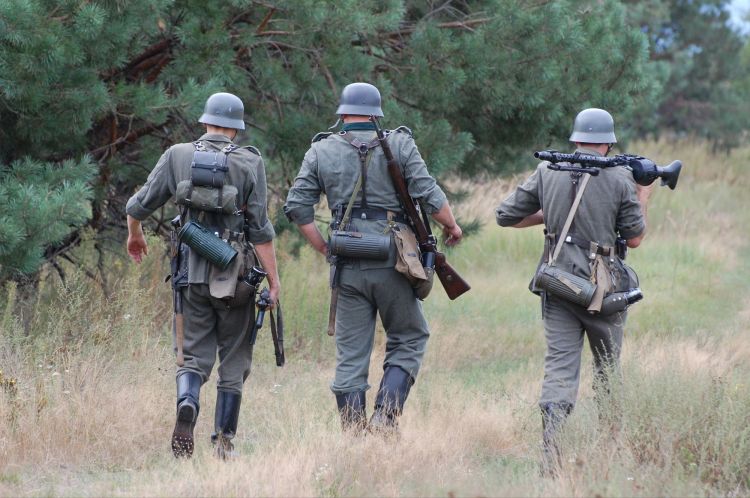
Rather than going along with the typical tropes (which would probably sell more books), it is important to me to get at the viewpoint of those who have been demonized as favoring or “complicit in” the rule of Hitler.
I will be honest: my heart convicts me that a lot of the tropes we rely on in Historical Fiction are just not true. I love flipping the script and, for example, challenging people to think about what kind of man an SS officer might really have been, rather than just accepting what we’ve been told about him.
As I said before, there were bad apples in every corner of society. There were also some true heroes. There was a preponderance of “just average guys.” There were also people caught between their convictions and the cold, hard reality of life.
One simply can’t write honestly about the German perspective without getting to know their story in full. Maybe that’s why so few choose to do it. It requires consulting primary sources as well as revisionist sources in order to get another perspective on events. I have immersed myself in it, and as I said, I never intended to do it, nor did I want to. As a rule, I have always hated conflict.
Looking back, though, I have no regrets. Simply reading revisionist history, and even considering that some of it might be accurate, does not make a person a holocaust denier or a conspiracy theorist. It makes them a person who senses something is amiss, a person who is desperate to get at the truth. Well-researched revisionist history contains perspectives that we need to consider.
I am certainly no fan of Stephen King, but even he is advocating reading banned books. I doubt he means reading revisionist history about the Second World War, or primary sources from the National Socialists, but every time I pick up something like that, I give him a nod.
Unless perhaps the Nazis should have thrown their own books into the bonfire on May 10, 1933?
All Right, Then. What About the Holocaust?
This is the issue that pulls at a person’s heartstrings. Whether it breaks your heart or makes you angry, it is the leading argument against any kind of alternate perspective of WWII history. It immediately shuts down any other discussion of what was or was not true about the war, even though it was just only one piece of a much larger picture.
It is dealt with in plenty of other books, and that’s why I don’t deal with it very often in my books.
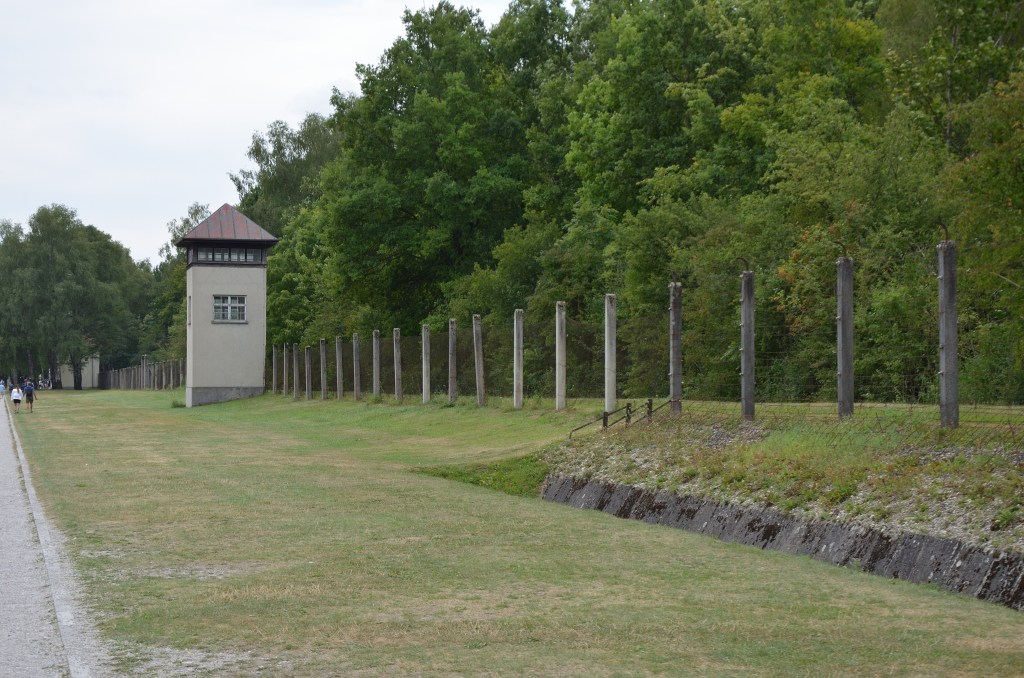
People will be arguing until “Kingdom Come” how much the average German really knew about what was going on. I don’t think they knew any more or less about what was going on in their society than we know about ours. Who can tell what is a lie and “what is truth”?
What I do know is that when I see the question Have We Learned Anything? being asked, for me, it’s a resounding “No,” and as long as we’re unable to have honest, respectful discussions, we won’t.
Ultimately, no one can know the whole truth about what went on before, during, and after the world wars. Certainly there were cover-ups, conspiracies, propaganda of all shades, and an abundance of slander and vilification.
There are ugly truths, and I believe they exist on all sides. These are things we don’t like to think about because we’re tempted to take it personally. It dings our pride as a victorious nation whose boys went to war believing they were fighting the good fight. My own grandfather was involved in the war, as most Americans of my generation could say. If the Allies recorded history in a way that is favorable but falsified, that doesn’t make him any more or less of a hero–like his German counterparts, he was doing his duty. As he was commanded.
Again, my goal is to, as accurately as possible, create fictional stories that reflect the perspectives of German individuals and allow them to wrestle with these things as they would have in real life. I am especially interested in those whose experiences have been sidelined in favor of the Germans we are comfortable talking about (whether those in the resistance, the “one good Nazi” trope in fiction, or true historical figures like Dietrich Bonhoeffer, Wilm Hosenfeld, and Claus von Stauffenberg). I want to create a bridge of understanding because the narrative is so institutionalized, and yet there is so much that still hasn’t been said. If God uses my stories to get people to think, and opens up a door to honest conversation, that’s all I can hope for.
If you want to be informed about the latest on the Aubrey Taylor Books Blog, sign up below. Posts focus primarily on writing, German history and travel, as well as films and books. I will also introduce you to other authors in a variety of genres, so drop your email to stay up-to-date!

 Aubrey Taylor Books
One thought on “Have We Learned Anything: My Thoughts as an Author of German-Perspective WWII Fiction”