
Today’s post will be the first in a new series that includes:
Film Reviews and Reflections
Book Reviews and Reflections
I have watched so many great movies and read so many fascinating books in the last few years. I decided that I need a place to share reviews and thoughts, especially with those who share my interest in the German perspective of the Second World War.
Let me start off by saying that a lot of these books and films may put off readers who are sensitive in certain areas. That is why I decided to share them here, rather than in my monthly newsletter. Naturally, war films and books are going to contain violence. If they are honest and represent the times accurately, they may contain things like cussing, sexual content, coarse joking, drinking, etc… So please don’t just pick up or stream something based on my recommendation without doing your research and determining if it’s right for you.
Also, I am not a real “technical” reviewer so I hope you are not looking for a scene by scene critique. At least not as a rule.
I’m going to kick things off with a film we watched in September, Downfall. Those who follow me on Instagram may recognize some of this content from a post I made on 9/26.
Downfall had been recommended to me a number of times, but had fallen way down on my list. Honestly, I didn’t realize it was a German film. If I had, I would have watched it right away. I’ve come to prefer German war films simply because of their raw honesty. After discovering a list of the top five German WW2 movies on YouTube, this was the only one I hadn’t seen.
So naturally I decided it was time to watch it.

Downfall takes the viewer into the Führerbunker (Hitler’s underground bunker) in Berlin at the end of the Second World War. The scenes cut between the battle raging on the streets and the ailing Führer arguing with his generals deep below the surface.
This bunker wasn’t simply a concrete room underground where Hitler eventually shot himself. It was an entire command center where dozens of people lived for weeks, including a young secretary named Traudl Junge, who chose to remain in the bunker when everyone else (including Eva Braun) was urging her to get out. The film (at least, the American version) is bookended by Frau Junge’s commentary. More on that later.
As I said, there were those who were fighting on the streets (for more on this, a great memoir is Soldat by Major Siegfried Knappe, who describes the Battle of Berlin in great detail). That part of the drama focuses on the Hitler Youth, a stark reminder that by this time, much of Germany was being defended by the very young, very old, and very desperate.
There was the arguing amongst the generals and the Führer, as well as high ranking Nazis Goebbels and Bohrmann in the bunker. There were the troops huddled together underground. There were the wounded in the makeshift hospitals. Then there were the partiers, living it up in what may well have been their last few weeks of life. I’m still not sure what I think about Eva Braun. The way she was portrayed in the film, she seemed to have her own false reality. And there were those who willingly came to the bunker to live and die with Hitler. Josef Goebbels’ wife and children were among them.
It is easy to say, “They all got what they deserved,” or “Good riddance.” Yet the film portrays the suffering and devastation of this “downfall” in a raw and brutally honest way, down to the fact that the leader of the Third Reich is suffering from Parkinsons and is increasingly delusional. Bruno Ganz did an excellent job with a role that I’m sure few people would want to undertake.
This type of Second World War film could only be made by the Germans, because they are both deeply aware of the sins of the Nazis and of the great suffering of their people. Just recently, a few different Germans have made similar remarks to me, regarding the situation in Ukraine: “Germans know what it is like to have your cities destroyed.”
A German filmmaker can tell the whole story of their people. You feel the hopelessness and desperation. In spite of the inhumanity of which we knew the Nazi regime was capable, is it really human to sit there and feel glad while the “bad guys” pick themselves off one by one?
I sat in stunned silence as the film ended, wiping tears out of my eyes. I do not support the politics of that regime (as it says on the front page of my site), but I do spend a good deal of time “living” in it. Because of the last few years of immersion, it is significant when something can move me this much. Every actor was well placed, every role well played, and whether it was excellent filmography or something else, the past became almost tangible as I watched this film.
Seeing all these disillusioned, broken people killing themselves and each other, or fighting for survival as the Russians closed in (who were just as brutal), one cannot feel glad, even if they are the “bad guys.” How do I feel? It’s not something I can summarize in one sentence, or even a paragraph. It’s the reason I write German perspective fiction, because there is not simply one way to feel. While we may spend the rest of our lives trying to understand things like this, God understands all things perfectly, and his heart weeps for the sin of humanity.
At the end of the film, a mature Traudl Junge reflects on her involvement as a secretary to the Führer. The same year that she took the job, Sophie Scholl was martyred. Ms. Junge says that for that reason, she cannot use youth as an excuse. She could have found out the truth.
I have to ask myself whether that is true. Hindsight is always 20/20. There are a million ways in which we could say “I should have known.” But is that reality? Each of us are born into different circumstances, with different temperaments, abilities, surroundings, access to different information, etc. Even here in America, nobody can agree on what the government is doing. Nobody really knows. Do we really think it was any different in the Germany of the 1930s and 40s?
It sharpens my conviction that only God can give meaning to any of this. What happened in the past is still being woven into the tapestry of time, and we can’t fight darkness with violence. We fight it with light.
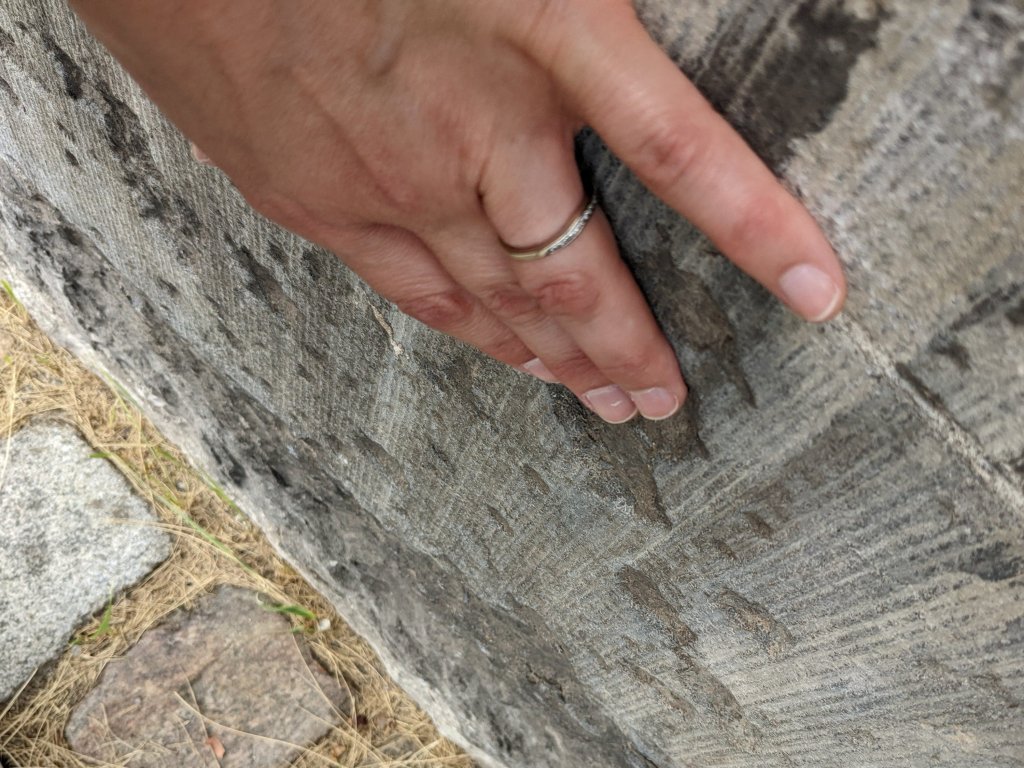
Finally, the pictures below were taken in Berlin last summer (2022). A few buildings still bear scars of the 1945 battle, sobering reminders that this film was not fiction.

 Aubrey Taylor Books
2 thoughts on “Film Reviews and Reflections: Downfall”